

How many bags of mulch in a cubic yard?
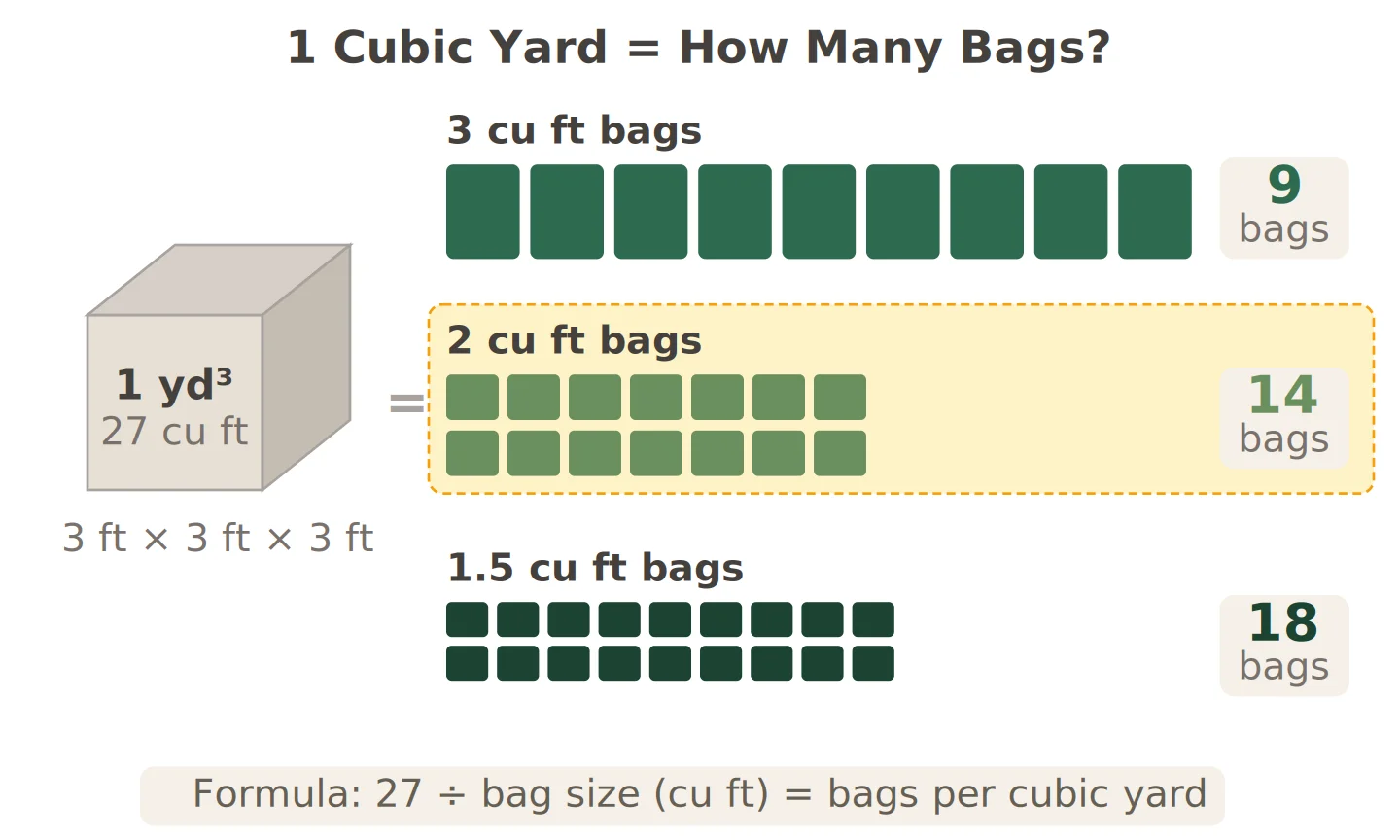
One cubic yard equals 13.5 standard bags — so 14 if your store sells the common 2 cu ft size. Here's the math for every bag size, plus how much ground one bag actually covers.
One cubic yard of mulch equals 13.5 standard bags — so you need 14 bags if your store sells the common 2-cubic-foot size. That’s the quick answer. But bag sizes vary, and grabbing the wrong count is one of the most common mulch-buying mistakes.
This guide covers every bag size you’ll find at a garden center, shows how much ground each bag covers, and includes a scenario table so you can look up your project and know exactly how many bags to load into the cart. If you already know your square footage, our free mulch calculator does the math in seconds.
One cubic yard = 27 cubic feet. That’s the only number you really need to memorize.
2 cu ft bags (most common): 14 per yard. 1.5 cu ft: 18 per yard. 3 cu ft: 9 per yard.
The formula: 27 ÷ bag size in cu ft = bags per yard. Always round up.
Bags per cubic yard — every size
The math is always the same: divide 27 by the bag size and round up.
A cubic yard is a volume measuring 3 feet on each side — 3 × 3 × 3 = 27 cubic feet. Mulch bags are sold in cubic feet, so converting between the two is just division. The table below covers every bag size currently sold at major garden centers and home improvement stores. If you need the volume for something other than mulch, our cubic yard calculator works out cubic feet, cubic yards, and cubic meters for any bulk material.
| Bag size | Exact math | Bags to buy |
|---|---|---|
| 1 cu ft | 27 ÷ 1 = 27 | 27 bags |
| 1.25 cu ft | 27 ÷ 1.25 = 21.6 | 22 bags |
| 1.5 cu ft | 27 ÷ 1.5 = 18 | 18 bags |
| 2 cu ft | 27 ÷ 2 = 13.5 | 14 bags |
| 2.5 cu ft | 27 ÷ 2.5 = 10.8 | 11 bags |
| 3 cu ft | 27 ÷ 3 = 9 | 9 bags |
The 2-cubic-foot row is bolded because it’s by far the most common size at retailers like Home Depot and Lowe’s. But don’t assume — always check the label on the bag. Some brands sell 1.5-cubic-foot bags in packaging that looks nearly identical to the 2-cubic-foot version. The difference between 14 and 18 bags per yard adds up fast.
What each bag actually covers
This is the table to screenshot at the store. Knowing how many bags make a cubic yard is useful for bulk comparisons. But what most people really want to know is simpler: how much ground does one bag cover? That depends on the bag size and the depth you spread it.
| Bag size | Coverage at 2″ | Coverage at 3″ | Coverage at 4″ |
|---|---|---|---|
| 1 cu ft | 6 sq ft | 4 sq ft | 3 sq ft |
| 1.25 cu ft | 7.5 sq ft | 5 sq ft | 3.75 sq ft |
| 1.5 cu ft | 9 sq ft | 6 sq ft | 4.5 sq ft |
| 2 cu ft | 12 sq ft | 8 sq ft | 6 sq ft |
| 2.5 cu ft | 15 sq ft | 10 sq ft | 7.5 sq ft |
| 3 cu ft | 18 sq ft | 12 sq ft | 9 sq ft |
At the most common depth of 3 inches, a standard 2-cubic-foot bag covers 8 square feet — roughly a 2 × 4 foot strip. That’s not much ground, which is one of the reasons people consistently underestimate how many bags they need.
The formula behind the table: divide the bag size in cubic feet by the depth in feet. For a 2-cubic-foot bag at 3 inches: 2 ÷ 0.25 = 8 square feet. For the full coverage breakdown by depth, see how much does a yard of mulch cover. If you need help measuring irregular bed shapes first, start with how to calculate mulch.
How many bags for your project
Find your area and depth. The table does the rest.
The table below uses standard 2-cubic-foot bags — the size you’ll find at most stores. If your store sells a different size, use the formula at the bottom of this section to adjust.
| Area | At 2″ deep | At 3″ deep | At 4″ deep |
|---|---|---|---|
| 100 sq ft | 9 bags | 13 bags | 17 bags |
| 200 sq ft | 17 bags | 25 bags | 34 bags |
| 300 sq ft | 25 bags | 38 bags | 50 bags |
| 500 sq ft | 42 bags | 63 bags | 84 bags |
| 1,000 sq ft | 84 bags | 125 bags | 167 bags |
Two things jump out from the table. First, depth matters enormously — going from 2 inches to 4 inches nearly doubles the bag count. Second, large areas eat bags fast. A 500-square-foot yard at 3 inches needs 63 bags. That’s a lot of lifting, which is why larger projects usually shift to bulk delivery.
200 sq ft front bed at 3 inches (new mulch)
Example500 sq ft yard refresh — existing mulch at 1.5 inches
ExampleThe formula for any bag size: (square feet × depth in inches ÷ 12) ÷ bag size in cubic feet = bags needed. Round up to the next whole number.
When bags stop making sense
The switch to bulk is usually about labor, not sticker price.
At a typical retail price of about $4 per bag (2 cu ft), 14 bags cost roughly $56 to equal one cubic yard. Bulk mulch from a landscape supply yard usually runs $30 to $55 per cubic yard, with delivery adding another $50 to $150 depending on distance. For small projects — one or two yards — bagged mulch is often cheaper on sticker price once delivery is factored in. The real case for switching to bulk isn’t saving money on the first yard; it’s avoiding the labor of hauling 30, 50, or 80 bags.
Past 3 cubic yards, the labor equation tilts hard. Moving 42+ bags means multiple trips to the store, lifting each bag several times between store and garden, and splitting them open one at a time. A single bulk delivery drops it all in one pile. Pure dollar savings on bulk don’t usually get dramatic until 4 or 5 yards, where the lower per-yard price more than offsets the delivery fee. For small projects under 2 cubic yards (roughly 28 bags), bags are often the more practical choice — no delivery fee, no minimum order, and they fit in a car trunk. For a full comparison including delivery logistics, color options, and shelf life, see bulk vs. bagged mulch.
Common mistakes with bag math
- Confusing cubic feet with cubic yards. One cubic yard is 27 cubic feet — not 1 cubic foot. If a calculator gives you 50 cubic feet and you order 50 cubic yards, you’ll end up with 27 times more mulch than you need. Always check the unit before ordering.
- Not checking existing mulch depth. If there’s already 1 to 2 inches on the ground, you don’t need a full fresh layer. Measure what’s there and buy only enough to fill the gap. Rutgers Extension caps total depth at 3 inches — including old mulch still in place. Piling new on top of old can smother roots and divert water away from the soil.
- Forgetting to round up. If the math says 31.25 bags, you need 32. Half-bags don’t exist at the register. Finishing with one bag left over beats coming up short halfway through the bed.
- Assuming all bags are the same size. A bag labeled “mulch” could be 1.5, 2, or 3 cubic feet — the bags often look similar. Check the number on the front of the bag before loading the cart. The difference between 1.5 and 2 cu ft is 4 extra bags per yard, roughly $16 at retail.
Frequently asked questions
Is a cubic yard the same as a regular yard?
No. A regular yard is a length — 3 feet. A cubic yard is a volume — 3 feet long, 3 feet wide, and 3 feet deep, which comes out to 27 cubic feet total. When garden centers sell mulch “by the yard,” they mean by the cubic yard.
Do all mulch brands use the same bag size?
No. The two most common sizes are 2 cubic feet and 1.5 cubic feet, with some premium or specialty brands selling 3-cubic-foot bags. Always check the number printed on the front of the bag — it’s required to be listed. If your store carries 1.5-cu ft bags, you’ll need 18 per cubic yard instead of 14.
What if my store only carries 1.5-cubic-foot bags?
You’ll need 18 bags to equal one cubic yard (27 ÷ 1.5 = 18). For project planning, each 1.5-cu ft bag covers about 6 sq ft at 3 inches deep. Same formula as always — figure out your total cubic feet, then divide by 1.5 instead of 2.
Can I measure by the bag instead of calculating?
Yes, if you know one shortcut. A standard 2-cu ft bag covers 8 sq ft at 3 inches deep. So you can walk your bed, estimate the area, and divide by 8. For a 200-sq ft bed: 200 ÷ 8 = 25 bags. This skip-the-formula method works well for quick estimates.
Is 27 the only number I really need to remember?
For bag math, yes. There are 27 cubic feet in every cubic yard, no matter what material you’re buying. Divide 27 by your bag size to get bags per yard. Multiply your cubic yards by 27 to get total cubic feet, then divide by bag size for the project total. Everything starts with 27. Because the conversion is the same for every material, our cubic yard calculator handles soil, gravel, and stone the same way it handles mulch.
Related reading
Methodology & sources
Bag conversion math and per-bag coverage data drawn from university extension publications and verified against major US retailer pricing. All numbers verified manually before publication.
Bag conversion math and coverage
- Texas A&M AgriLife Extension — How Much Compost, Soil, or Mulch? — link
- Mississippi State Extension — P2301: Mulches for the Landscape — link
- University of Hawaii CTAHR — L-3 Calculation Methods — link
- Iowa State Extension — How to Determine Amount of Mulch Needed for a Garden Bed — link
- Clemson Extension — Mulch Matters — link
- UF/IFAS Florida-Friendly Landscaping — Calculating Mulch — link
- UNH Cooperative Extension — Mulching Trees and Shrubs — link
Depth and over-mulching guidelines
- Rutgers Cooperative Extension — FS099: Problems With Over-Mulching Trees and Shrubs — link
- UF/IFAS Gardening Solutions — Mulches — link
- Iowa State Extension — Using Mulch in the Garden — link
- Mississippi State Extension — Mulch How-Tos for the Landscape — link
Sources are cited for reference only. The institutions and retailers named on this page do not sponsor or endorse MaterialCalcs, and we are not affiliated with them. Retail prices, where shown, were checked by hand and vary by store and region.