

How to calculate how much mulch you need
One formula handles every shape — rectangles, circles, odd-shaped beds. Measure the area, pick a depth, run the numbers.
Figuring out how much mulch you need doesn’t require a math degree. One formula handles everything — rectangles, circles, odd-shaped beds, the whole yard. Get the area, pick a depth, run the numbers, and head to the store with the right amount.
Or skip the math and use our free mulch calculator — it does the same thing in seconds.
The core formula: area (sq ft) × depth (inches) ÷ 12 ÷ 27 = cubic yards.
The shortcut: sq ft × depth in inches × 0.0031 = cubic yards.
The conversions: 1 cubic yard = 27 cubic feet ≈ 14 standard bags (2 cu ft each). Always round up and add 10% for waste, settling, and uneven ground.
The basic formula
Every mulch calculation comes down to volume. You’re filling a space to a certain depth, so you need three things: length, width, and depth.
Then convert cubic feet to the unit your supplier sells — cubic yards for bulk, or number of bags for bagged mulch.
That number 27 comes from the definition of a cubic yard: 3 feet long, 3 feet wide, 3 feet deep. Multiply those together and you get 27 cubic feet in every cubic yard.
How to measure your area
Grab a tape measure. Most beds fit one of three shapes.
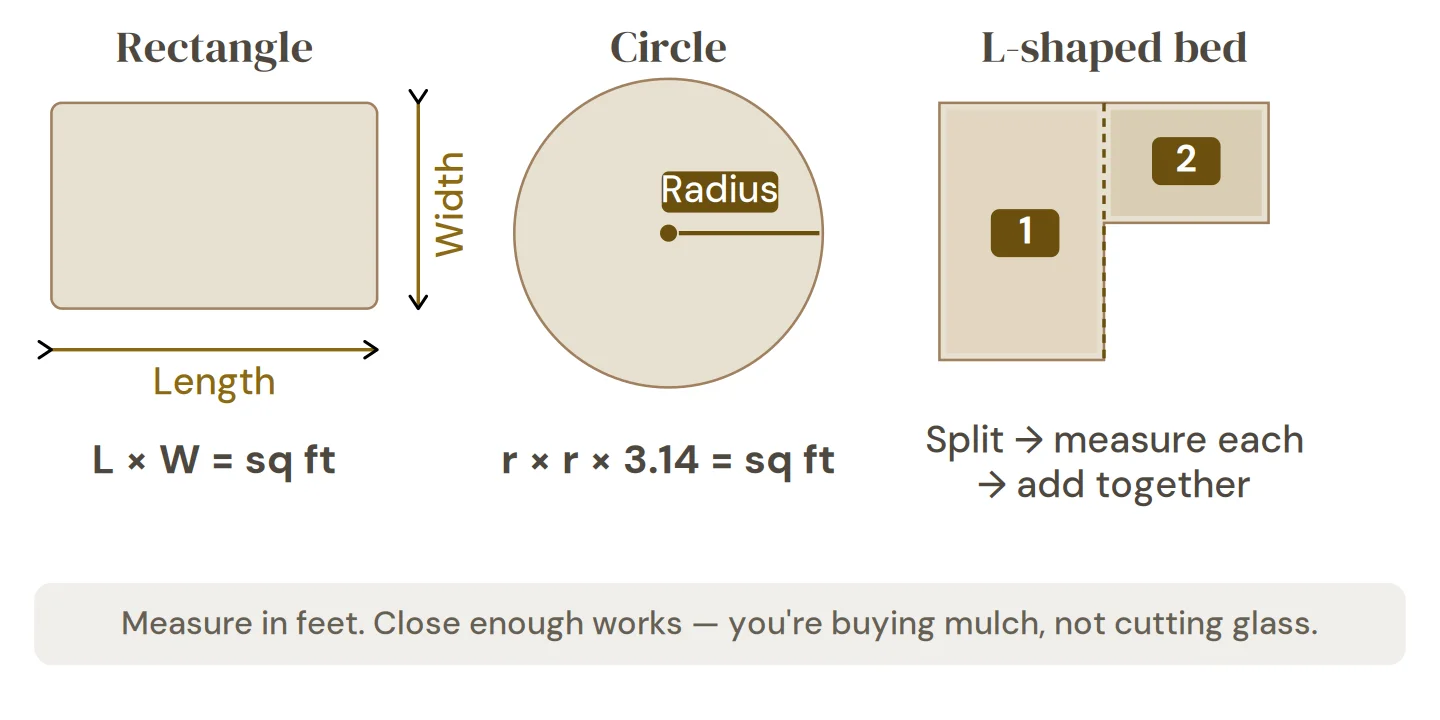
Rectangles and squares. Multiply length by width. A bed running 20 feet along the house and 4 feet deep equals 80 square feet. Simple.
Circles. Measure from the center of the circle to its edge — that gives you the radius. Multiply the radius by itself, then by 3.14.
A circular bed with a 6-foot radius works out to 6 × 6 × 3.14 = 113 square feet.
Irregular shapes. Most garden beds aren’t perfect rectangles or circles. Break the area into smaller shapes you can measure — a couple of rectangles, maybe a triangle or a half-circle. Calculate each piece separately, then add the results together for the total.
It doesn’t need to be precise to the inch. Close is good enough — you’re buying mulch, not cutting glass.
Two to four inches covers most situations
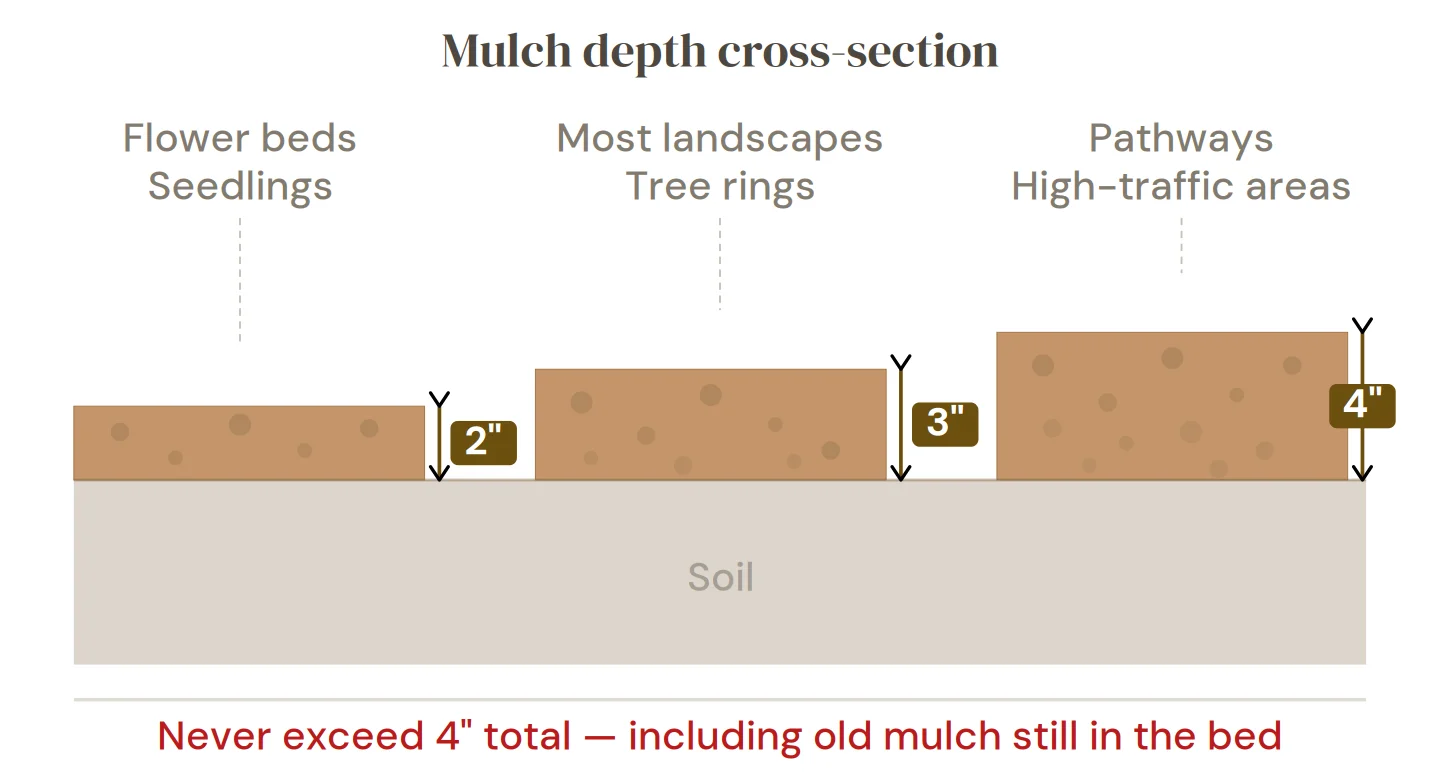
Depth matters more than most people realize — too thin and weeds push through; too thick and roots suffocate. Recommended depths vary by what you’re mulching:
| Bed type | Recommended depth | Why |
|---|---|---|
| New flower beds & shrubs | 2–3 in | Standard layer for weed suppression and moisture retention without smothering young roots. |
| Pathways & high-traffic areas | 3–4 in | Heavier layer holds up to foot traffic and resists displacement. |
| Around established trees | 2–4 in | Spread out to the drip line. Keep mulch a few inches off the trunk. |
| Vegetable gardens | 2–3 in | Pull mulch back to about 1 in right around seedlings and small transplants (UF/IFAS). |
| Refreshing existing mulch | 1–2 in | You’re topping up, not starting over. More builds up over time and smothers crowns. |
Coarser materials like wood chips and bark nuggets can go deeper — up to 4 inches on well-drained soil. Fine-textured mulch like double-shredded hardwood should stay thinner, around 2 inches, because it packs tightly and blocks air.
On heavy clay or areas with poor drainage, keep everything to 2 inches. Waterlogged mulch suffocates roots instead of protecting them.
And never pile mulch against tree trunks. Rutgers puts the gap at 3 to 5 inches around the stems of young plants and 8 to 12 inches around mature tree trunks; Penn State says 8 to 10 inches for mature trees. The mulch volcanoes you see in parking lots aren’t something to copy — they cause bark rot, attract rodents, and invite disease.
Converting to cubic yards and bags
Bulk mulch is sold by the cubic yard. Bags come in cubic feet. Once you have your total in cubic feet, divide by 27 to get cubic yards — that’s the number you give a landscape supplier for bulk delivery.
For bagged mulch, divide cubic feet by the bag size. Most standard bags hold 2 cubic feet, though 1.5 and 3 cubic foot bags also exist. Always check the label.
| Bag size | Bags per cubic yard |
|---|---|
| 1.5 cu ft | 18 bags |
| 2 cu ft | 14 bags |
| 3 cu ft | 9 bags |
As a general rule, bulk delivery makes sense once you need more than about 5 cubic yards — that’s roughly 68 standard bags. Below that threshold, bags are usually cheaper and easier to transport in a car or SUV. For the full cost comparison, see bulk vs. bagged mulch.
A real mulching project
Two complete walkthroughs — from tape measure to store receipt.
Front yard: two beds + one tree ring
ExampleRefreshing an existing bed
ExampleThat’s the entire process. Measure, multiply, convert, round up. Whether you’re covering 50 square feet or 5,000, the steps are identical — only the numbers change. For quick reference tables showing how far a cubic yard stretches at every depth, see how much does a yard of mulch cover.
Common mistakes to avoid
- Confusing cubic feet with cubic yards. One cubic yard equals 27 cubic feet. Confusing the two means ordering 27 times too much or too little. Always double-check which unit your supplier uses.
- Forgetting existing mulch. Before adding fresh material, rake back what’s there and measure the depth. The refreshing example above cut an 18-bag order down to 9 with this one step.
- Ignoring settling. Organic mulch compresses over time. Per UF/IFAS research, 3 inches you spread today may be closer to 2 inches within a couple of years. The 10% buffer accounts for the initial settling.
- Mixing units. If your tape gives you inches for length and width, convert to feet first — divide by 12. Mixing inches and feet in the formula produces wildly wrong results.
Frequently asked questions
How much mulch do I need per square foot?
At 2 inches deep, one square foot needs about 0.17 cubic feet. At 3 inches it’s 0.25 cu ft. At 4 inches it’s 0.33 cu ft. Multiply these by your total square footage to get the project total.
How many bags of mulch do I need for 100 square feet?
Using standard 2 cu ft bags at 3 inches deep: 100 × 0.25 = 25 cu ft, divided by 2 = 12.5 bags. Round up to 13, then add one for waste. Buy 14 bags.
Is there a quick way to estimate without a calculator?
Yes. At 3 inches deep, one cubic yard covers roughly 100 square feet (108 exactly, but 100 is easier to remember). So for a 300 square foot area at 3 inches, you need about 3 cubic yards. Add a little extra for waste and you’re close enough for most projects.
How much mulch do I need for 1,000 square feet?
At 2 inches deep: about 6.2 cubic yards or 84 bags. At 3 inches: about 9.3 cu yd or 125 bags. At 4 inches: about 12.3 cu yd or 167 bags. All bag counts assume standard 2 cu ft bags. Add 10% for waste and settling.
How do I calculate mulch for a sloped area?
Measure the slope as if it were flat — length and width along the ground surface. The formula stays the same. On steep slopes, add 15 to 20 percent extra because gravity pulls mulch downhill during rain. Use a heavier mulch like double-shredded hardwood that locks together on slopes.
Should I round up or down when ordering mulch?
Always round up. Suppliers sell bulk mulch in whole or half cubic yards, and stores sell whole bags. Rounding down means a second trip. Rounding up gives you a little extra for patching thin spots or topping off next spring.
Related reading
Methodology & sources
Calculation formulas and depth recommendations in this article come from university extension publications. All math was verified manually with a calculator before publication.
Formula sources
- Iowa State Extension — How to Determine Amount of Mulch Needed (Steil, 2025) — link
- Mississippi State Extension — P2301 Mulches for the Landscape (Wilson & Bachman) — link
- Texas A&M AgriLife Extension — How Much Compost, Soil or Mulch? — link
- UF/IFAS Gardening Solutions — Choosing and Installing Mulches — link
Depth and settling sources
- Rutgers Cooperative Extension — FS099 Problems With Over-Mulching Trees and Shrubs — link
- Penn State Extension — Mulching Landscape Trees — link
- UF/IFAS — EP625 Mulching Herbs, Vegetables and Fruit Trees in the Florida-Friendly Edible Landscape — link
- Colorado State Extension — GardenNotes #245 Mulching — link
- UF/IFAS — FR052 Landscape Mulches: How Quickly Do They Settle? — link
- Oregon State Extension — EC 1629 Mulching Woody Ornamentals with Organic Materials — link
Sources are cited for reference only. The institutions and retailers named on this page do not sponsor or endorse MaterialCalcs, and we are not affiliated with them. Retail prices, where shown, were checked by hand and vary by store and region.