

How much does a yard of mulch cover?
One cubic yard covers 108 square feet at 3 inches deep — about a 10 × 10 area. Coverage tables for every depth, plus how far a pickup truck load actually goes.
One cubic yard of mulch covers 108 square feet at 3 inches deep — roughly a 10 × 10 foot area. That’s the number most people need, since 3 inches sits in the middle of the commonly recommended 2-to-4-inch range. But coverage changes with depth, so if you’re going thinner or thicker, the area changes fast.
This page gives you the reference tables for every common depth, plus worked examples and a few practical details that affect how far your mulch actually goes. If you already know your square footage and just want the answer, our free mulch calculator does the math in seconds.
At 3 inches deep: 1 cu yd covers 108 sq ft. At 2 inches: 162 sq ft. At 4 inches: 81 sq ft.
The formula: 324 ÷ depth in inches = square feet per cubic yard.
The rule: always add 10% for waste, settling, and uneven ground.
Coverage by depth — the quick reference
One number to remember: 324. Divide by your depth in inches and you have your answer.
A cubic yard is 27 cubic feet. Spread that volume over a surface, and the area it covers depends entirely on how deep you go. Where does 324 come from? Take 27 cubic feet, multiply by 12 (to convert depth from inches to feet in the same step), and you get 324. That’s the magic number behind every mulch coverage chart you’ll ever see.
That same math works for any bulk material, not just mulch. If you’re ordering soil, gravel, or stone, our cubic yard calculator handles six area shapes and adds the weight in tons.
| Depth | 1 yard covers | 2 yards cover | 3 yards cover |
|---|---|---|---|
| 1 inch | 324 sq ft | 648 sq ft | 972 sq ft |
| 1.5 inches | 216 sq ft | 432 sq ft | 648 sq ft |
| 2 inches | 162 sq ft | 324 sq ft | 486 sq ft |
| 2.5 inches | 130 sq ft | 259 sq ft | 389 sq ft |
| 3 inches | 108 sq ft | 216 sq ft | 324 sq ft |
| 4 inches | 81 sq ft | 162 sq ft | 243 sq ft |
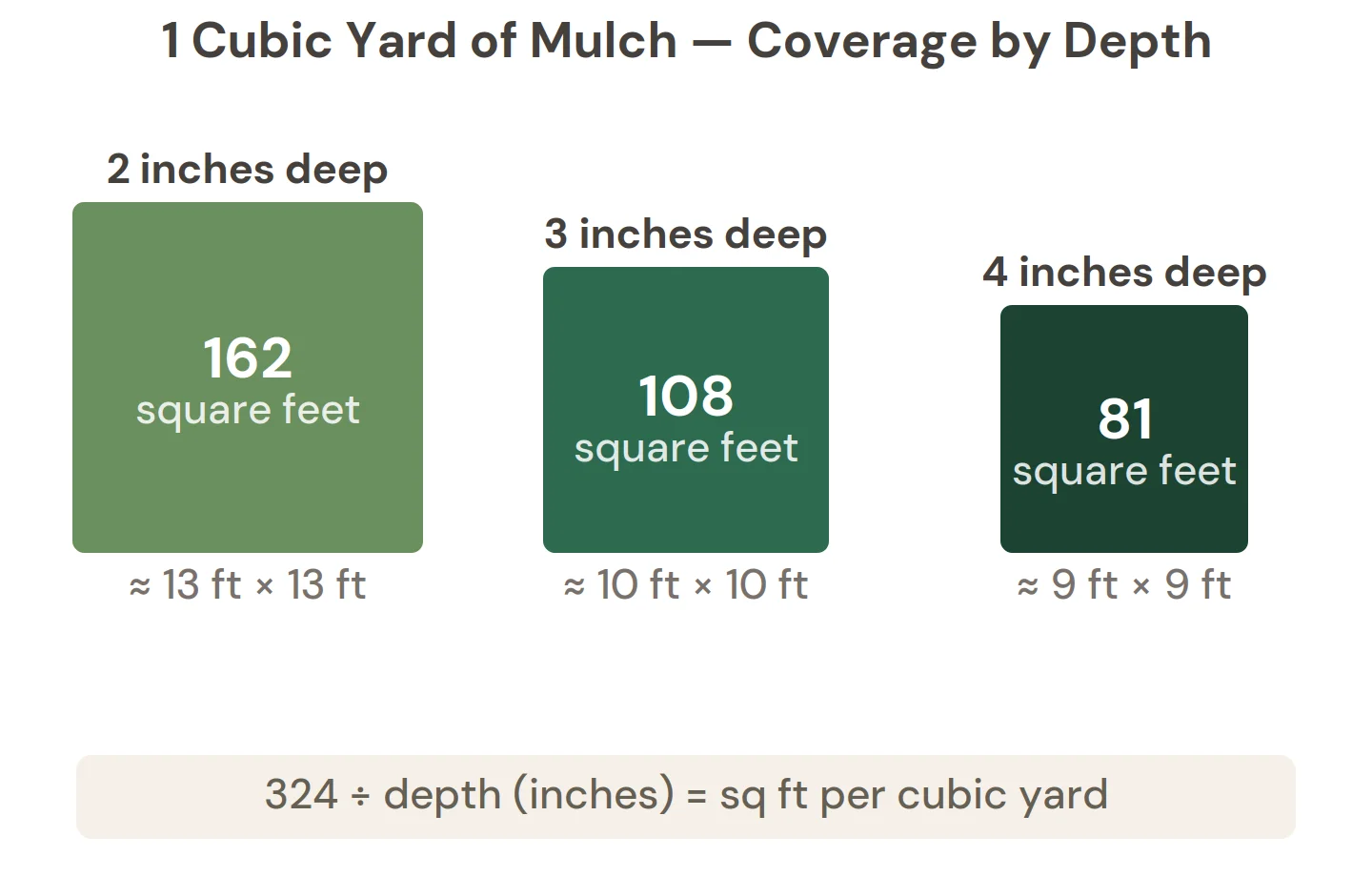
The 2-inch, 3-inch, and 4-inch rows are bolded because those are the depths used in the vast majority of residential mulching. If you only remember one line, make it the 3-inch row: 108 square feet per cubic yard.
How to use the coverage table
Divide your total square footage by the coverage number for your depth. Round up.
The table also works in reverse: if you know your area and depth, divide the area by the per-yard coverage to get the cubic yards you need. Then round up and add 10%.
300 sq ft front bed, new mulch at 3 inches
Example500 sq ft yard refresh — existing mulch at 1.5 inches
ExampleThat second example is the one most people skip. Measuring what’s already there before ordering can save you 30 to 50 percent on material costs. For the full step-by-step formula — including how to measure irregular shapes, circles, and L-shaped beds — see how to calculate mulch.
Quick bag conversion
Not buying in bulk? One cubic yard equals 27 cubic feet. Divide by your bag size to get the bag count.
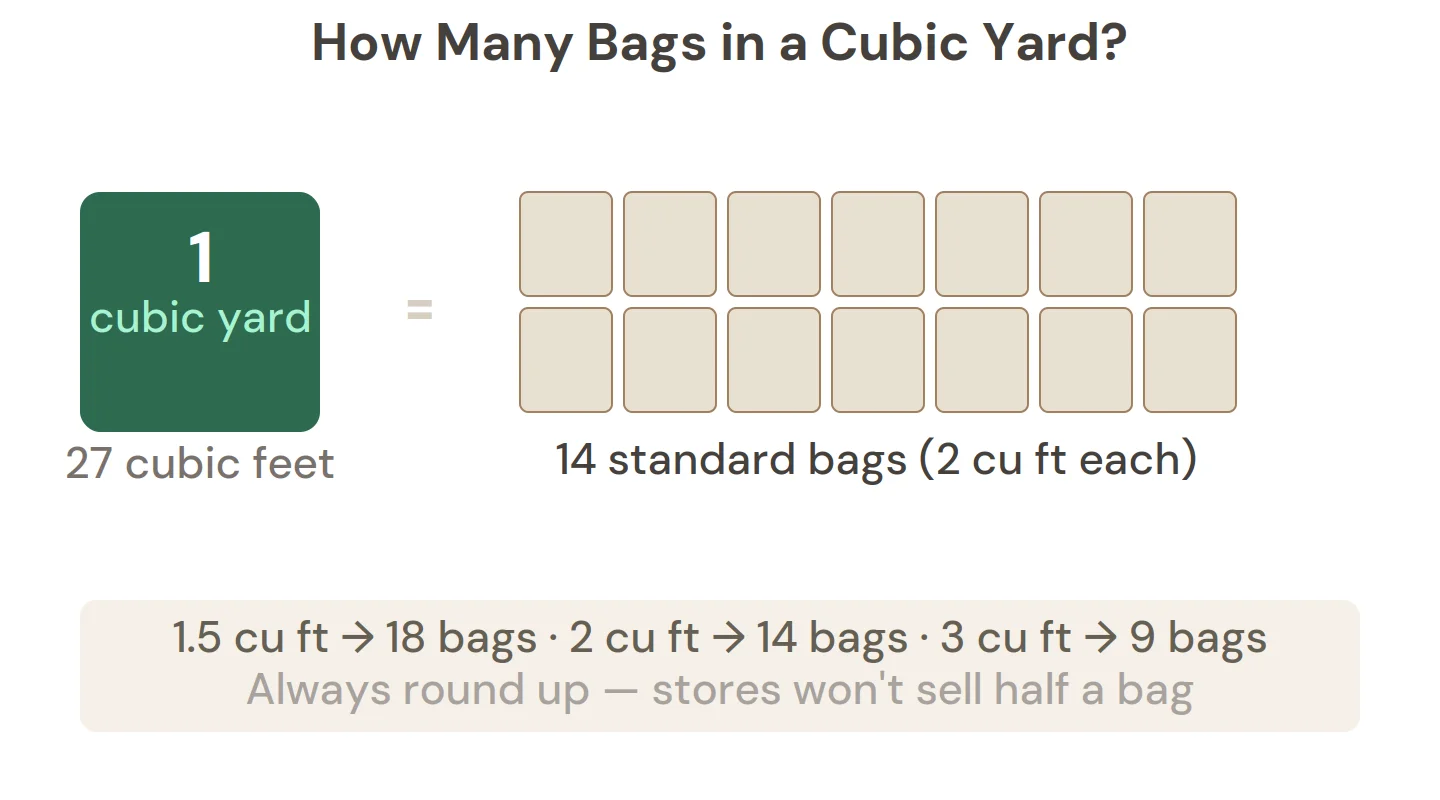
2 cu ft bags (standard): 14 bags per cubic yard. 1.5 cu ft bags: 18 per yard. 3 cu ft bags: 9 per yard.
One standard 2 cu ft bag covers about 8 square feet at 3 inches deep. So for a 100-sq ft bed at 3 inches, you need roughly 13 bags. For the full breakdown — including every bag size, scenario tables, and when bagged mulch beats bulk — see how many bags of mulch in a cubic yard.
What a pickup truck covers
A full-size pickup, filled level, holds about 2.5 cubic yards (UNH Cooperative Extension). At 3 inches deep, that covers about 270 sq ft.
Hauling your own mulch saves the delivery fee. Here’s what you can fit and cover in a single load at 3 inches deep:
Full-sized pickup: about 2.5 yd³ → 270 sq ft. Midsize or compact truck: typically about 1.5 yd³ → 162 sq ft.
Keep weight in mind. Mulch is heavier than it looks — especially when fresh or wet. A full bed of bulk mulch can easily push your truck past its payload limit. Check your truck’s payload rating before filling the bed to the brim, and remember that wet mulch straight from the supplier’s pile weighs a lot more than dry bags on a store shelf.
Why coverage varies in practice
The table gives you perfect math. The real world adds a few variables.
Settling. All organic mulch compresses over time. A University of Florida study tracked six mulch types over two years. Pine bark and cypress maintained about two-thirds of their original depth after two years. Pine straw nearly disappeared. If you spread 3 inches of hardwood bark today, expect closer to 2 inches within a couple of years — still above the minimum effective depth, but noticeably thinner.
Existing mulch. This is the single biggest factor most people ignore. If you already have an inch or two of mulch from last year, you don’t need a full 3-inch application. Rake it, measure the depth in a few spots, and subtract from your target. This alone can save you an entire cubic yard or more on a mid-sized project.
Uneven ground. Slopes, tree roots, and dips all consume extra mulch. The standard advice is to add 10 percent to your calculated total. On very uneven terrain — rocky hillsides, heavily rooted areas — bump that to 15 or even 20 percent.
Mulch type. The coverage table assumes a uniform volume-to-area ratio, which holds true regardless of material. A cubic yard of pine straw takes up the same volume as a cubic yard of hardwood bark. The difference shows up in settling rate and weight afterward, not in initial coverage area.
Common coverage mistakes
- Skipping the depth check. Ordering a full 3-inch layer on top of existing mulch is the most common waste of money in residential mulching. Measure before you order. If you have 1.5 inches left, you only need 1.5 inches of new material — not 3.
- Confusing cubic feet and cubic yards. One cubic yard equals 27 cubic feet. Mixing up the two units means ordering 27 times too much or too little. If your supplier quotes in cubic yards and your math is in cubic feet, divide by 27 before placing the order.
- Going deeper than the range. More mulch isn’t better. Penn State Extension puts the ceiling at 4 inches and warns that anything more can harm a tree’s root system. Rutgers Extension is stricter: no more than 3 inches total, including any mulch remaining from previous years, and no more than 2 inches on compacted or poorly drained soil. Excess mulch diverts water away from roots, reduces soil oxygen, and creates conditions for root rot.
- Piling mulch against trunks. Volcano mulching causes bark decay, root girdling, and pest problems. Rutgers puts the gap at 3 to 5 inches from young stems and 8 to 12 inches from mature tree trunks; Penn State says 8 to 10 inches for mature trees. Either way, the root flare — where the trunk meets the soil — should always be visible.
Frequently asked questions
How much does a cubic yard of mulch weigh?
It varies widely depending on the material and how wet it is. Freshly chipped or rain-soaked mulch can weigh several hundred pounds per cubic yard — much more than the same mulch when dry and aged. Dry bagged mulch is the lightest; a standard 2 cu ft bag typically weighs 30 to 50 pounds. Always check your vehicle’s payload rating before hauling bulk mulch, and plan for two trips if the load feels heavy.
Can I use the coverage table for half-yard or quarter-yard amounts?
Yes. The coverage scales evenly. Half a cubic yard covers 54 sq ft at 3 inches deep — exactly half of 108. A quarter yard covers 27 sq ft. This is useful for small beds or top-ups where a full cubic yard would be too much.
Does mulch type affect coverage area?
No — not at the point of application. A cubic yard is a cubic yard regardless of material. What changes is how quickly the mulch settles afterward. Pine bark and shredded hardwood hold their depth well (losing about a third over two years). Pine straw decomposes much faster and may need refreshing within a year.
How thick should mulch be?
Two to three inches for most landscape beds, and 3 to 4 inches around trees and shrubs on well-drained ground. Drop to 2 inches on compacted or poorly drained soil. Vegetable beds take 2 to 3 inches, but pull it back to about 1 inch right around seedlings and small transplants (UF/IFAS). On the upper limit the sources split: Penn State Extension and the International Society of Arboriculture put the ceiling at 4 inches, while Rutgers Extension caps the total at 3 inches — including any old mulch from previous years — and 2 inches on poorly drained soil. Never exceed 4 inches with organic mulch.
Is 324 the same as dividing by 12 and then by 27?
Yes, exactly. The number 324 combines two conversions: dividing by 12 to turn inches into feet, then dividing by 27 to turn cubic feet into cubic yards. Since 12 × 27 = 324, you can do it in one step. Multiply your square footage by the depth in inches and divide by 324 to get cubic yards. Our cubic yard calculator runs that conversion for any material and shows the result in cubic feet, cubic yards, and cubic meters.
Related reading
Methodology & sources
Coverage formulas, depth recommendations, and settling research drawn from university extension publications. All numbers verified manually before publication.
Coverage formulas and calculation methods
- UF/IFAS Gardening Solutions — Mulches — link
- Mississippi State Extension — P2301: Mulches for the Landscape — link
- Texas A&M AgriLife Extension — How Much Compost, Soil, or Mulch? — link
- Iowa State Extension — How to Determine Amount of Mulch Needed for a Garden Bed — link
- University of Hawaii CTAHR — L-3 Calculation Methods — link
- UNH Cooperative Extension — Mulching Trees and Shrubs — link
Settling research and depth guidelines
- UF/IFAS — FR052: Landscape Mulches: How Quickly Do They Settle? — link
- UF/IFAS — EP625: Mulching Herbs, Vegetables and Fruit Trees in the Florida-Friendly Edible Landscape — link
- Rutgers Cooperative Extension — FS099: Problems With Over-Mulching Trees and Shrubs — link
- International Society of Arboriculture — Proper Mulching Techniques — link
- Colorado State Extension — Mulching — link
- Penn State Extension — Mulching Landscape Trees — link
Sources are cited for reference only. The institutions and retailers named on this page do not sponsor or endorse MaterialCalcs, and we are not affiliated with them. Retail prices, where shown, were checked by hand and vary by store and region.