

How long does mulch last?
Most bark mulches last 2 to 4 years. Pine straw is gone in months. Rock lasts forever. Here's how to tell when your beds need a refresh.
Most bark and wood mulches last 2 to 4 years before they thin enough to need replenishing. Pine straw is gone in months. Inorganic mulch like rock and gravel lasts essentially forever.
This guide breaks down lifespan by mulch type, what a university settling study actually measured over two years, and exactly how to tell when your beds need a refresh. If you’re planning a top-up, our free mulch calculator works out the volume in seconds.
Bark mulch (pine, hardwood): 2 to 4 years — long-lasting because of high lignin content.
Wood chips: 1 to 2 years. Pine straw: 6 to 12 months. Leaves and grass clippings: weeks to months. Rock and gravel: essentially permanent.
The rule: check depth each spring with a ruler — replenish when it drops below 2 inches.
Lifespan by mulch type
Bark outlasts everything else. Pine straw and leaves disappear fastest. Here’s the full breakdown.
The table below combines data from multiple university extension services. Lifespan means the time before the mulch thins enough that you need to add more — not the time until every last particle is gone.
| Mulch type | Typical lifespan | When to replenish |
|---|---|---|
| Pine bark (nuggets) | 2–4 years | When depth drops below 2″ |
| Shredded hardwood bark | 2–4 years | When depth drops below 2″ |
| Cedar / cypress bark | 2–4 years | When depth drops below 2″ |
| Wood chips (arborist) | 1–2 years | Annually or when thin spots appear |
| Pine straw (needles) | 6–12 months | Once or twice per year |
| Leaf mold | 1–2 years | Annually |
| Cocoa bean hulls | ~1 season | Each spring |
| Straw | ~1 season | Each growing cycle |
| Grass clippings | Weeks | Every few weeks |
| Gravel / stone | Permanent | Rarely, if ever |
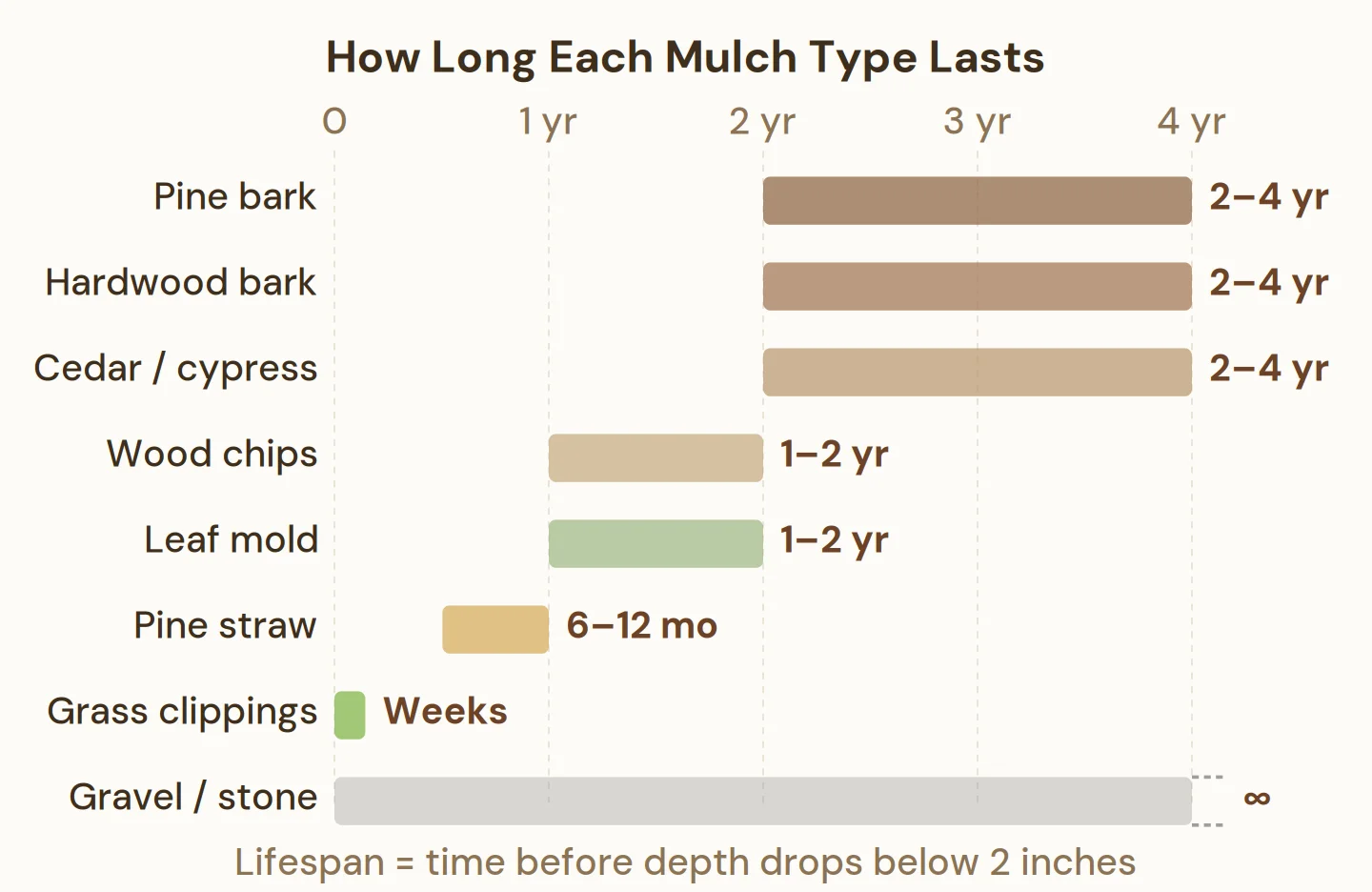
The pattern is straightforward: bark outlasts everything else because it’s high in lignin, a natural compound that resists microbial breakdown. Oregon State Extension notes that bark decomposes more slowly than wood chips specifically because of its higher lignin content. Cedar and cypress bark are especially durable because they also contain natural phenolic compounds that resist decay. Wood chips decompose faster than bark because they include the softer heartwood, not just the outer bark. And anything leaf-based — pine straw, grass clippings, shredded leaves — breaks down quickly because leaves have far less lignin than wood.
A university study measured six mulches over two years
Researchers at UF/IFAS installed six common landscape mulches at a uniform depth of 9 cm (about 3.5 inches) and measured how much remained after one year and two years. The differences were dramatic.
| Mulch type | Depth remaining after 2 years | % of original depth |
|---|---|---|
| Melaleuca | 7 cm (2.8 in) | 78% |
| Pine bark | 6 cm (2.4 in) | 67% |
| Cypress | 6 cm (2.4 in) | 67% |
| Eucalyptus | 5 cm (2.0 in) | 56% |
| Utility mulch (mixed) | 5 cm (2.0 in) | 56% |
| Pine straw | 1 cm (0.4 in) | 11% |
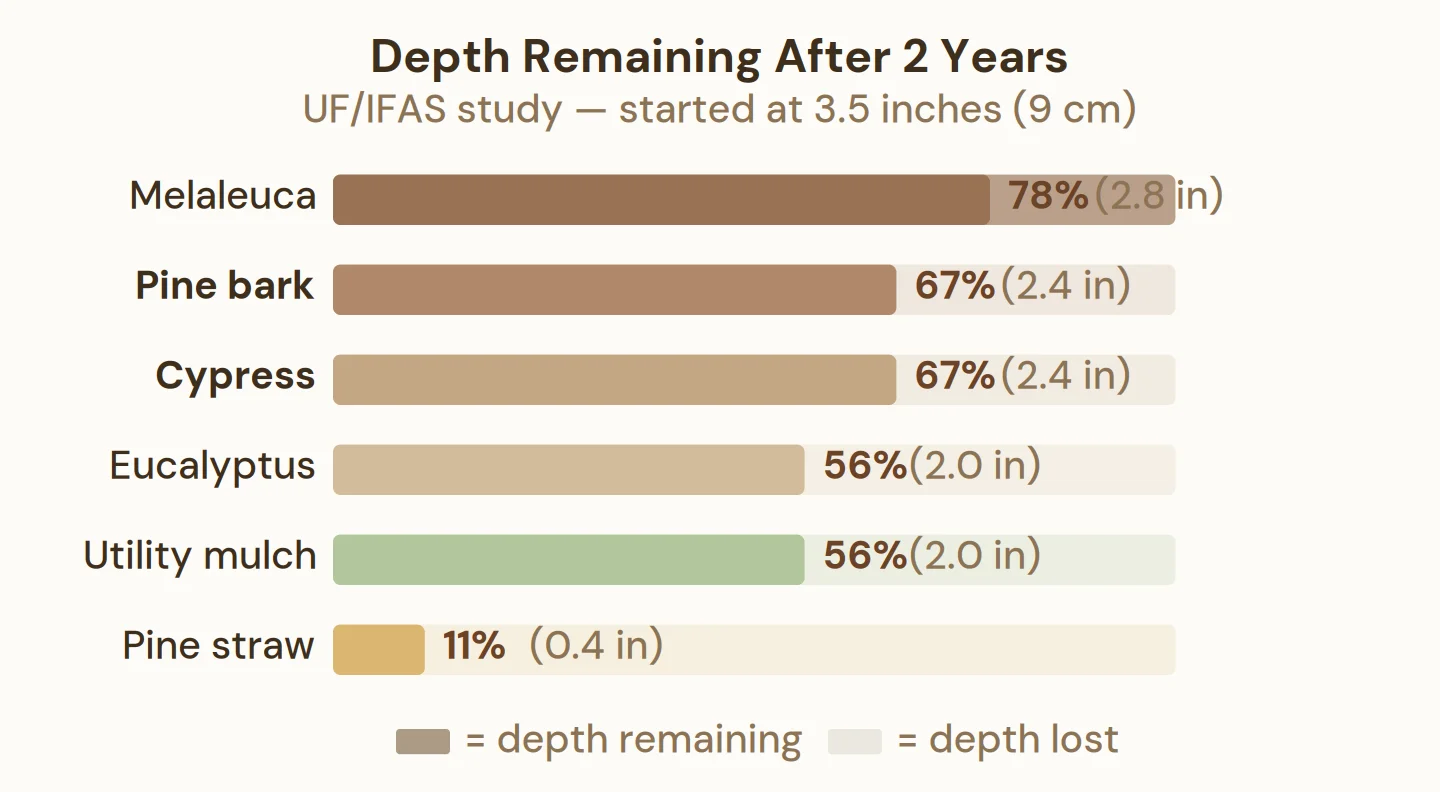
The headline finding: pine bark and cypress both retained about two-thirds of their original depth after two full years — enough to still provide weed suppression, moisture retention, and temperature insulation. Pine straw, on the other hand, lost half its depth in the first year and was almost completely gone by year two.
The study’s conclusion: four of the six mulches maintained a useful depth for at least two years when applied at 3.5 inches. Pine straw was the clear exception, needing replenishment well before the two-year mark.
What makes mulch break down faster
Four factors determine whether your mulch lasts one year or four.
Particle size. Finer mulch decomposes faster because it has more surface area exposed to soil microbes. Double-shredded bark breaks down noticeably faster than chunky bark nuggets. For the longest lifespan, choose coarser grades.
Climate. Warm, wet conditions speed up microbial activity. The UF/IFAS settling study was conducted in north-central Florida — a warm, humid climate. In cooler or drier regions, the same mulch will typically last longer. Conversely, hot, rainy climates will push mulch toward the shorter end of the lifespan range.
Depth. A thinner layer disappears sooner, simply because there’s less material to break down. Starting at the recommended 2 to 3 inches gives you a useful buffer. Starting at 1 inch means the mulch will need replenishing within a single season regardless of type.
Soil contact. Decomposition happens primarily at the interface where mulch meets soil. Microbes in the top layer of soil break down the organic material from below. This is normal and beneficial — it adds organic matter to your soil. But it also means the bottom of the mulch layer thins first, even when the top still looks fresh.
How to tell when it’s time
One tool, one minute, once a year.
Push a ruler or a stick into the mulch in a few spots each spring. If the depth is below 2 inches in most areas, it’s time to add more. You don’t need to wait until the mulch is completely gone — in fact, waiting too long means weeds get a foothold and moisture loss accelerates.
Other signs that your mulch needs attention:
Bare soil showing through. If you can see dirt between the mulch particles, the layer is too thin. Weeds will follow quickly.
Faded, grey color. Aged mulch loses its color long before it loses all its function, but a grey, washed-out appearance often coincides with significant depth loss.
Weeds sprouting easily. A healthy 2 to 3 inch mulch layer suppresses most annual weeds. If weeds are pushing through easily, the mulch has thinned below the effective threshold.
Matted, water-repellent surface. Fine-textured mulch can develop a crusted layer that sheds water instead of letting it through. If water pools on top of your mulch instead of soaking in, rake it to break up the crust before adding fresh material.
How to replenish without over-mulching
Add on top, don’t replace. And measure first.
Measure what’s already there. This is the step most people skip. If you still have 1.5 inches of old mulch and your target is 3 inches, you only need 1.5 inches of new material — not the full 3 inches. Skipping this measurement is one of the most common ways mulch beds end up dangerously deep over time. For help calculating how much to buy for a top-up, see how many bags of mulch in a cubic yard.
Rake before adding. Lightly rake the existing mulch to break up any matted or crusted layers. This restores air and water flow and helps the new mulch blend with the old.
Don’t remove old mulch. University of Florida Extension specifically recommends against replacing mulch entirely. The old layer is still contributing organic matter to the soil, and removing it can damage shallow surface roots that have grown into the mulch.
Watch the total depth. This includes old mulch plus new. Rutgers Extension caps the total at 3 inches — including anything left from previous years — and at 2 inches on compacted or poorly drained soil; Penn State puts the outer limit at 4. Past that, mulch intercepts water, starves roots of oxygen, and creates conditions for fungal diseases. If your existing layer is already at 2.5 inches and just looks faded, a light rake is all you need — no new mulch required.
Keep mulch away from trunks. Every time you add mulch, pull it back 3 to 5 inches from the stems of young plants and 8 to 12 inches from mature tree trunks (Rutgers; Penn State says 8 to 10 inches for mature trees). Mulch piled against bark traps moisture and encourages rot.
500 sq ft bed, existing mulch settled to 1 inch
ExampleFrequently asked questions
How often should I mulch per year?
It depends on the type. For bark and shredded hardwood, once a year is the maximum — and often less. Many bark mulches hold up for 2 to 3 years before needing a top-up, so a thin refresh layer is all you need in most springs. Pine straw is the exception: plan to replenish it once or twice a year. Check the depth each spring and let the ruler decide, not the calendar.
Should I remove old mulch before adding new?
Usually no. University of Florida Extension recommends adding a thin layer on top of existing mulch rather than replacing it entirely. The old mulch is still adding organic matter to your soil, and removing it can damage shallow roots. Just measure the existing depth, rake to loosen any matting, and add only enough to bring the total back to 2 to 3 inches.
Does mulch color affect how long it lasts?
The dye itself doesn’t change the decomposition rate — it’s purely cosmetic. What matters is the material underneath the color. Penn State Extension notes that the wood used in dyed mulch is frequently recovered from used pallets and construction waste, which tends to break down faster than natural bark mulch. If longevity is a priority, choose undyed bark over dyed shredded wood.
Does bagged mulch last longer than bulk?
No. Once spread in your beds, bagged and bulk mulch of the same type decompose at the same rate. The packaging doesn’t affect the material’s longevity. Choose between bagged and bulk based on cost and convenience, not durability.
Will mulch attract termites?
Not in the way most people fear. University of Florida research finds that termites in bagged mulch survive poorly — most don’t survive the chipping process, and those that do are cut off from their colony. The greater risk to a house is termites already established on the property.
Where mulch does matter is depth and placement against the building. UF/IFAS warns that mulch piled more than 4 to 6 inches deep along a foundation hides the inspection space and keeps the soil there moist and moderate — good conditions for termites that are already present. Building code requires at least a 6-inch inspection gap between mulch and siding, so leave that gap and keep mulch off wood trim and window frames. Switching to gravel isn’t an automatic fix either: in one study, termites foraged more actively under pea gravel than under organic mulches.
Related reading
Methodology & sources
Mulch lifespan data and settling research drawn from university extension publications. All claims verified against original sources before publication.
Settling and longevity research
- UF/IFAS — FR052: Landscape Mulches: How Quickly Do They Settle? — link
- UF/IFAS Extension Lake County — What Is the Best Mulch to Use in the Florida Landscape? (2022) — link
Lifespan by type and decomposition factors
- Oregon State Extension — EC-1629: Mulching Woody Ornamentals with Organic Materials — link
- Clemson HGIC 1604 — Mulch — link
- UConn Extension — Mulch Basics — link
- Iowa State Extension — Using Mulch in the Garden — link
- Penn State Extension — Mulch: A Survey of Available Options — link
Replenishment, over-mulching, and safety
- UF/IFAS Gardening Solutions — Mulches — link
- UC Marin Master Gardeners — Applying Mulch — link
- Rutgers Extension — FS099: Problems With Over-Mulching Trees and Shrubs — link
- Penn State Extension — Mulching Landscape Trees — link
- Michigan State University Extension — Mulching Landscape Beds FAQs — link
- UF/IFAS — ENY-832 / IN651: The Facts About Termites and Mulch (revised 2023) — link
Sources are cited for reference only. The institutions and retailers named on this page do not sponsor or endorse MaterialCalcs, and we are not affiliated with them. Retail prices, where shown, were checked by hand and vary by store and region.