

Mulch vs. rock: which is better for your yard?
The right answer depends on what you're covering — not on style. Mulch wins around plants. Rock wins everywhere else.
The mulch vs. rock decision comes down to one thing: what’s underneath. Around plants that need healthy soil, organic mulch wins. Over hardscape, walkways, or fire-defensible zones, rock is the better call.
This guide breaks down the real cost over five years, the maintenance myth, the effect on soil and plants, and exactly when rock is the right choice. If you already know your bed size, our free mulch calculator prices out the mulch side in seconds.
For plant beds: organic mulch wins — it feeds the soil, insulates roots, and costs $30–55/yd³.
For hardscape: rock wins — permanent, fire-resistant, ideal for paths, xeriscapes, and foundations.
5-year material cost: pea gravel is cheapest (~$350), bark mulch costs $414–621, river rock ~$490. “Zero-maintenance” rock is a myth — weeds increase as silt builds up in the gaps.
Different jobs, different materials
Mulch and rock are built for different jobs: one feeds the soil, the other covers ground that doesn’t need it.
If you’re mulching around trees, shrubs, flower beds, or a vegetable garden, organic mulch wins. It keeps roots cool, holds moisture, and breaks down into nutrients your soil needs.
If you’re covering a utility strip, a dry-climate xeriscape, a fire-defensible zone, or a walkway with no plants, rock is the smarter material. It stays put, doesn’t decompose, and never needs replacing.
The mistake most homeowners make is treating this as a style preference. It’s not. Mulch and rock do fundamentally different things to the ground beneath them — and picking the wrong one costs you time, money, and dead plants.
Cost: upfront vs. long-term
Rock lasts forever, but that doesn’t always make it cheaper.
Upfront, organic mulch is cheaper. A cubic yard of bark mulch runs $30–55 at most landscape suppliers. The same volume of pea gravel runs $50–65, river rock $60–160, and lava rock anywhere from $60 to $340 — shipping from western quarries drives the high end in eastern markets.
But mulch needs replacing. Bark lasts 2–4 years before it decomposes enough to lose its weed-blocking and moisture-holding benefits. Rock doesn’t decompose at all.
That sounds like rock wins on long-term cost. Reality gets more complicated.
Five-year cost for a 500 sq ft bed at 3 inches depth
Example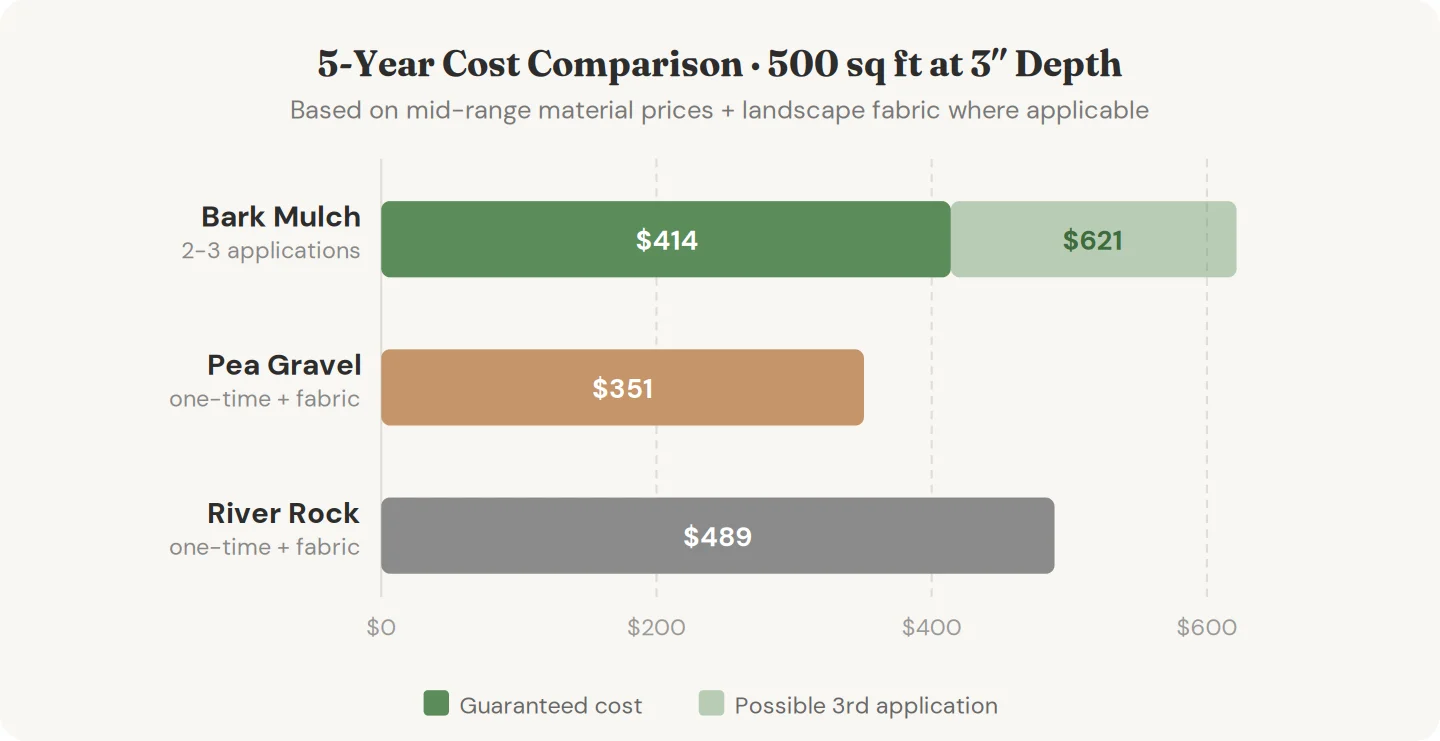
One note on those rock figures: they include landscape fabric. Skip it — which we recommend (see the FAQ below) — and rock drops to $276 for pea gravel and $414 for river rock.
Budget pea gravel does cost less over five years. River rock costs about the same as — or more than — two to three rounds of bark mulch. And this doesn’t include the hidden maintenance costs of rock — herbicide for weeds, supplemental watering for stressed plants, and the eventual removal bill if you change your mind.
Maintenance: the “zero work” myth
Rock looks clean for the first two years. Then the math flips.
The #1 reason homeowners choose rock is the promise of zero maintenance. Kansas State Extension calls this out directly: it’s a myth that gets worse every year the rock is in place.
Here’s what actually happens:
Year 1–2: Rock looks clean. Minimal weeds. You feel smart.
Year 3–4: Wind-blown soil and organic debris settle into the gaps between stones. This creates a thin layer of perfect seedbed. Weed seeds blow in and germinate right on top of the rock.
Year 5+: Landscape fabric underneath degrades, frays, and becomes visible. Weeds root through the fabric. The only removal options are hand-pulling or herbicides — a hoe is useless in rock. Leaves that land on gravel are nearly impossible to rake; they break down into fine pieces that accelerate the silting problem.
Meanwhile, organic mulch maintenance is straightforward: add a fresh 2–3 inch layer every one to two years. You can spread it over the old layer. No fabric needed. If you want to change your plantings, you just dig through it — try that with a bed full of river rock and degraded landscape fabric.
Soil health and plant growth
This is where the two materials aren’t even close. Organic mulch feeds soil. Rock doesn’t.
The USDA notes that both organic and inorganic mulches conserve water, suppress weeds, and moderate soil temperature — but only organic mulch adds organic matter as it decomposes.
Organic mulch decomposes over time and adds organic matter to the soil, which helps soil retain important plant nutrients such as potassium, calcium, magnesium, and iron. It feeds earthworms and beneficial microorganisms — nitrifying bacteria and mycorrhizal fungi — that help plants absorb nutrients. As it breaks down, it improves soil structure, reduces compaction, and increases water-holding capacity.
Michigan State University research found that 3 inches of wood chip mulch reduced midday soil temperature by 18°F — keeping roots well within their optimal range.
Rock does none of this. It doesn’t decompose, so it adds nothing to the soil — no nutrients, no organic matter, no microbial food.
One important nuance: CSU research found that fine gravel (under 1 cm diameter) does suppress weeds and reduce evaporation similarly to wood chip mulch. So pea gravel can function as genuine mulch for moisture and weed control — it just won’t feed the soil beneath it.
Where rock becomes a problem is heat. Rock absorbs and radiates significant heat — Kansas State Extension notes that it contributes to the heat island effect, raising soil temperature and hurting plants. That elevated soil temperature impairs root function, reducing the ability of roots to take up water and nutrients.
When rock is the right call
Rock isn’t bad — it’s just bad around plants that need healthy soil. There are several situations where rock is genuinely the better choice:
Dry climates and xeriscaping. CSU notes that dry-climate landscapes benefit most from gravel mulch: pea gravel improves water infiltration, especially in short, intense storms, while wood chips baked by intense sun can turn water-repellent and block water from reaching the soil. Drought-adapted plants often evolved in rocky, mineral soils and prefer the excellent drainage rock provides.
Fire-prone areas. Mineral mulch is the best option for fire-defensible landscapes. In wildland-urban interface zones, gravel around structures is a safety measure, not just an aesthetic one.
Foundation borders. A narrow rock strip immediately around your house protects against soil erosion, won’t float away in heavy rain, and doesn’t retain moisture against the foundation the way organic mulch can.
Slopes and erosion control. Rock stays in place on hillsides where organic mulch would wash or blow away. Just note that rock on slopes can still migrate downhill over time.
Cold-winter climates. This one surprises people: gravel’s warming effect can actually help in cold regions. CSU research found that gravel mulch warms the soil and enhances biological activity during cold months, resulting in more vigorous plants. Where wood chips insulate against temperature swings in both directions, gravel lets solar heat reach roots earlier in spring — a genuine advantage in short-season climates.
Utility areas and walkways. Paths, drainage channels, and non-planted utility strips don’t need soil nutrients. Rock is the natural fit.
Side-by-side comparison
The full breakdown in one place. Scan this before you buy.
| Factor | Organic mulch | Rock / gravel |
|---|---|---|
| Upfront cost | $30–55/yd³ | $50–340/yd³ (varies by type) |
| Lifespan | 1–4 years (type dependent) | Permanent (doesn’t decompose) |
| 5-year cost (500 sq ft) | $414–621 (2–3 applications) | $351–489 (one application + fabric) |
| Soil improvement | Yes — adds nutrients and organic matter | None |
| Temperature effect | Insulates soil, keeps roots cool | Absorbs and radiates heat |
| Moisture retention | Excellent — reduces evaporation, builds water-holding capacity | Reduces evaporation; excellent drainage but no soil benefit |
| Weed suppression | Good at 2–3″ depth | Good initially; degrades as silt accumulates |
| Fire resistance | Low (especially dry/fine material) | Excellent |
| Ease of removal | Easy — dig or rake | Very difficult once silted |
| Best for | Plant beds, gardens, trees, shrubs | Xeriscaping, paths, fire zones, foundations |
Frequently asked questions
Is rock cheaper than mulch in the long run?
It depends on the type of rock. Budget pea gravel ($50–65/yd³) is cheaper than organic mulch over five years because you only buy it once. But decorative river rock ($60–160/yd³) plus landscape fabric can cost as much or more than two full rounds of bark mulch — and that doesn’t include the weed maintenance rock eventually requires.
Can I mix rock and mulch in the same bed?
Yes, and many Extension sources recommend this approach. Use organic mulch in the root zone around plants (where soil health matters) and rock for borders, pathways, or transitions to hardscape. Clemson HGIC shows an example of using both on a sloped bed — rock holds mulch in place at the edges.
Can I put rock over old mulch?
It’s best to remove old mulch first. Old mulch will continue decomposing into organic material — and K-State Extension documents that organic debris accumulating in rock is exactly what creates weed problems over time. Removing old mulch before installing rock reduces that buildup from the start.
Should I put landscape fabric under rock mulch?
University Extension sources advise against it. Fabric initially blocks weeds, but wind-blown soil accumulates on top, creating a seedbed where weeds root through the fabric anyway. Over time the fabric degrades, frays, and restricts water and air movement to plant roots — reducing soil health and making plant replacement extremely difficult. If you must use rock in a planted area, skip the fabric and accept occasional hand-weeding instead.
Does rock mulch change soil pH?
Most common landscape rock is pH neutral and won’t affect your soil. That said, if you’re growing acid-loving plants like azaleas or blueberries, testing your soil pH annually is a good idea regardless of mulch type.
Related reading
Methodology & sources
Lifespan claims and maintenance research are drawn from university extension publications and the USDA. Cost ranges reflect posted prices from real landscape suppliers across all six US regions plus major retailers. Prices vary 2–5× by region, stone type, and grade, so figures here are representative ranges, not fixed quotes. All numbers were verified against original sources before publication.
Government & university sources
- USDA — Mulch (People’s Garden, Soil Health) — link
- Cal Fire — Defensible Space (Zone 0) — link
- Clemson HGIC — Mulch or Rock: Which Do You Prefer? (2025) — link
- Clemson HGIC 1604 — Mulch — link
- Colorado State Extension — CMG GardenNotes #245: Mulching — link
- CSU Pueblo County Extension — Landscaping With Rock (or not) — link
- K-State Extension Johnson County — Rock Mulch, a Solution, or a Problem? — link
- UNL Water — Mulch in the Landscape — link
- USU Extension — Water-Wise Landscaping: Mulch — link
- Oregon State Extension — EC-1629: Mulching Woody Ornamentals with Organic Materials — link
- UF/IFAS Orange County — Are Rock Yards Florida-Friendly? — link
- UF/IFAS Lake County — What Is the Best Mulch to Use in the Florida Landscape? — link
- MSU Extension — Mulching Landscape Beds FAQs (Cregg) — link
- MSU — Effect of Organic Mulches on Soil Properties (Cregg & Schutzki) — link
- UConn Extension — Mulch Basics — link
Pricing sources (posted supplier prices, verified spring 2026)
- Kirk Allen Landscape Supply — Stanhope, NJ (Northeast)
- Stone Creations — Mansfield, OH (Midwest)
- Texas Garden Materials — Houston, TX (South)
- Cummin Landscape Supply — Atlanta, GA (Southeast)
- Old Mill Landscape Supply — Spanish Fork, UT (Mountain)
- Sequoia & MRM Landscape Supply — CA / WA (West)
- Home Depot, Lowe’s (national retail)
Sources are cited for reference only. The institutions and retailers named on this page do not sponsor or endorse MaterialCalcs, and we are not affiliated with them. Retail prices, where shown, were checked by hand and vary by store and region.