

Types of mulch: which one belongs in your yard?
There are four families, not one long list. Wood and bark cover most yards, the light organics feed a vegetable bed, and two popular choices — rubber and landscape fabric — are the ones extensions tell you to skip.
Walk into any garden center in spring and you’ll face a wall of bags: shredded hardwood, pine nuggets, cedar, cypress, red, black, brown, rubber. They are not interchangeable, and the differences that matter are not the ones printed on the bag.
This guide sorts every common mulch into four families, tells you what each one does to your soil, and ends with a table matching material to job. Every claim comes from a university extension or arborist publication, named where it appears. Once you’ve picked one, our free mulch calculator works out how much to buy.
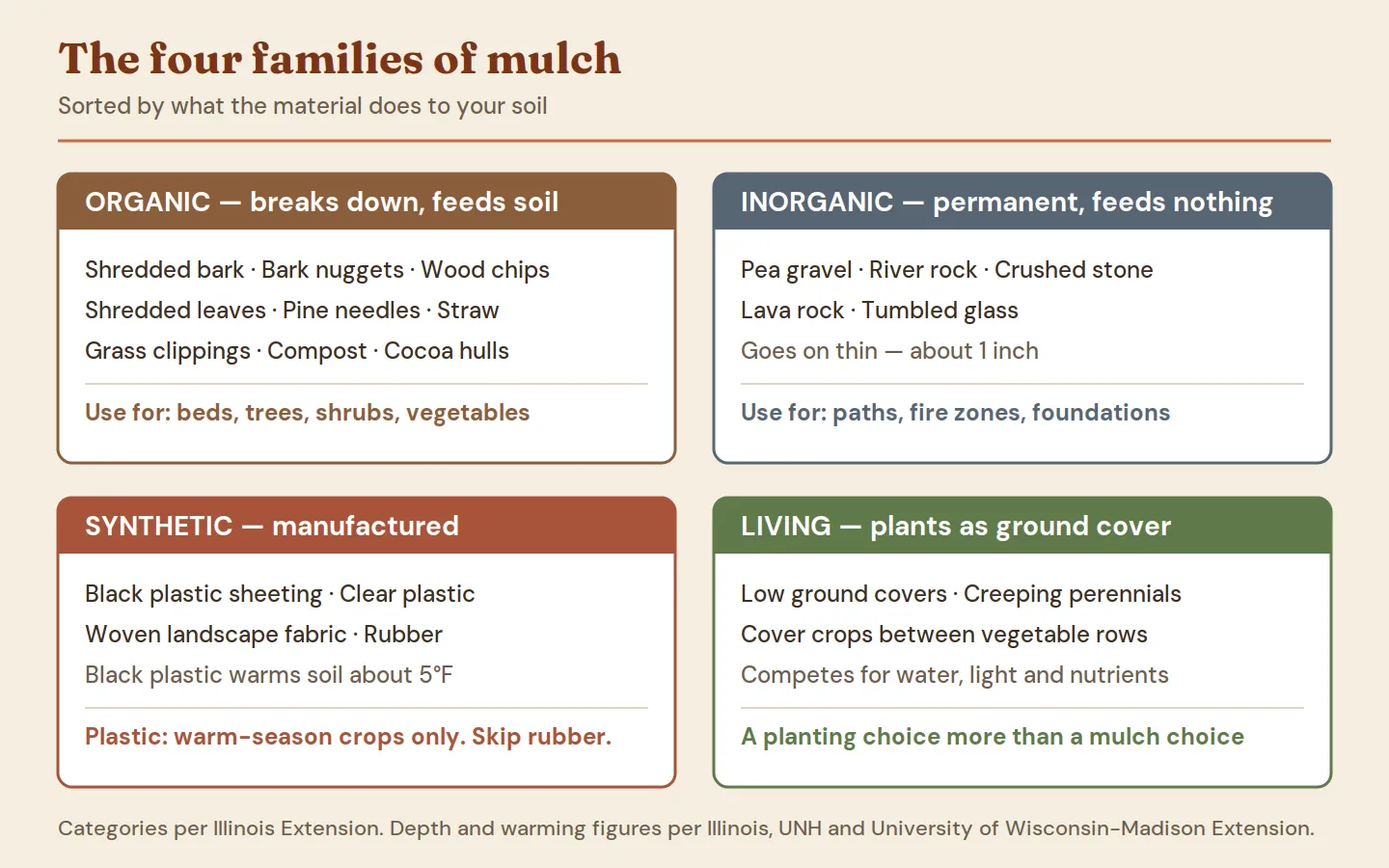
Four families: organic (bark, wood chips, leaves, straw), inorganic (stone, gravel), synthetic (plastic, fabric, rubber), and living (ground covers).
For most yards: shredded hardwood bark or arborist wood chips. Vegetables: straw, shredded leaves, or pine needles. Paths and fire zones: gravel. Skip: rubber, and fabric under mulch.
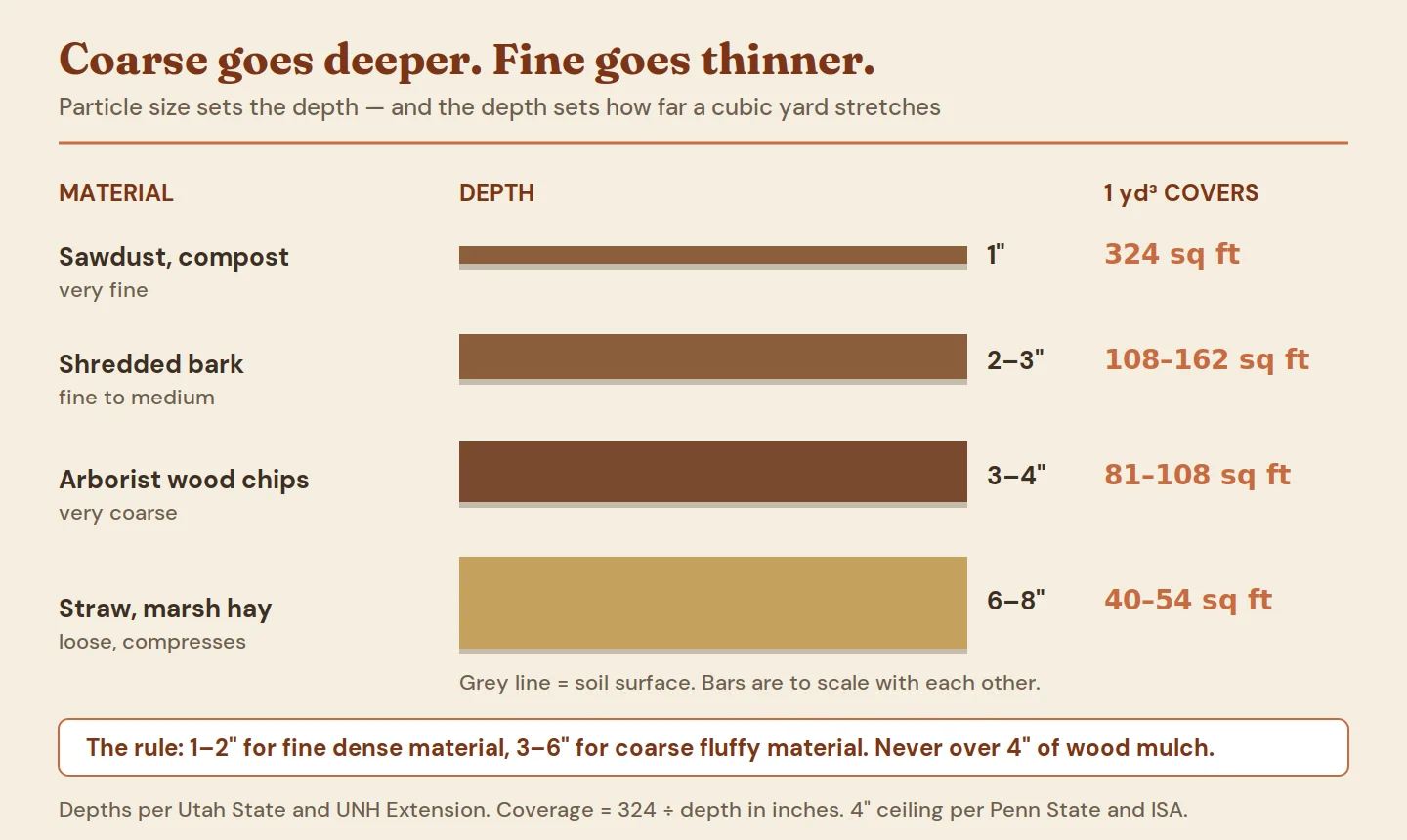
The rule: coarse material lasts longer and goes deeper; fine material breaks down faster and goes thinner.
The four families, and which one you need
Sort by what the material does to your soil, not by what it looks like.
Illinois Extension splits mulch into four groups. Organic mulches come from plants and break down — bark, wood chips, leaves, straw, pine needles, compost. Inorganic mulches are mineral and don’t — stone, gravel, tumbled glass. Synthetic mulches are manufactured — plastic sheeting, woven landscape fabric, shredded tire rubber. Living mulches are plants grown as ground cover.
Living mulch is the one you can set aside for now. A ground cover competes with your plants for water, light and nutrients, and Illinois notes that where those are limited — dry climates especially — a non-living mulch is the better choice. It’s a planting decision more than a mulching one.
That leaves three, and the table below is the short version of the whole guide.
| What you’re covering | Best choice | Why |
|---|---|---|
| Trees & shrubs | Arborist wood chips | Coarse, slow to break down, feeds soil |
| Flower & perennial beds | Shredded hardwood bark | Stays put, looks finished, lasts 2–4 years |
| Vegetable garden | Straw or shredded leaves | Breaks down fast, feeds next season’s soil |
| Slopes | Shredded bark or pine needles | Knits together, resists washing |
| Paths & utility strips | Gravel | Permanent, no soil to feed |
| Within 5 ft of the house | Gravel or hardscape | Fire clearance, termite inspection gap |
| Winter protection | Straw or marsh hay | Deep, loose, easy to pull off in spring |
One finding is worth pulling out of that table. Illinois Extension puts it plainly: across the research, arborist chips come out ahead of the alternatives on the balance of upsides to downsides — and because tree crews hand them over free, they cost nothing. The best mulch for most trees and shrubs is often the cheapest one available.
Wood and bark: what most people buy
Bark outlasts wood, and coarse outlasts fine. That’s the whole hierarchy.
Oregon State Extension explains the mechanism: bark decomposes more slowly than wood chips because it is higher in lignin, the compound that resists microbial breakdown. Wood chips include the softer heartwood, so microbes get through them faster. Cedar and cypress last longest of all, because they carry natural phenolic compounds that resist decay on top of the lignin.
Particle size does the rest. Coarse nuggets have air gaps, resist compaction and last years. Double-shredded bark mats down, seals the surface and disappears faster.
| Material | Texture | Lasts | Depth | 1 yd³ covers |
|---|---|---|---|---|
| Shredded hardwood bark | Fine to medium | 2–4 years | 2–3″ | 108–162 sq ft |
| Pine bark nuggets | Coarse | 2–4 years | 2–3″ | 108–162 sq ft |
| Cedar or cypress bark | Medium | 2–4 years | 2–3″ | 108–162 sq ft |
| Arborist wood chips | Very coarse, mixed | 1–2 years | 3–4″ | 81–108 sq ft |
| Sawdust | Very fine | 1 season | 1″ | 324 sq ft |
The coverage column is the one people forget at the register. A cubic yard spread 3 inches deep covers 108 square feet; the same yard at 4 inches covers 81. Our guide on how much a yard of mulch covers has the full table, and how long mulch lasts goes deeper on the lifespan figures.
Two practical differences between bark and chips. Pine bark nuggets float, so they wash out of beds that flood and off slopes in heavy rain. And fresh arborist chips are excellent around trees and shrubs but are not recommended around annuals and vegetables — University of Maryland Extension draws that line explicitly.
Red, black and brown: what the color actually is
The dye is harmless. What’s underneath it might not be.
Colored mulch is dyed wood, and UMass Amherst identifies the dyes themselves as ordinary pigments — carbon-based for black, iron oxide for red. Iron oxide is rust. Neither is a soil contaminant at the amounts used.
The question worth asking is what wood was dyed. Penn State Extension notes that the wood in dyed mulch is frequently recovered from used pallets and construction waste rather than milled bark. That matters twice over. Recycled construction wood breaks down faster than natural bark, so a dyed mulch may need replacing sooner than its color suggests. And lumber treated before 2004 may have been treated with chromated copper arsenate — CCA — which contains arsenic.
CCA was phased out of residential lumber in 2003 and 2004, so the risk is in old material entering the recycling stream, not in new production. It is a reason to read the bag rather than a reason to panic.
One more thing the color doesn’t change: the dye has no effect on decomposition rate. A black mulch and a brown mulch made from the same wood break down at the same speed. Color fades long before the mulch is spent, which is why beds look tired a year before they actually need topping up — and why you should measure the depth before buying more.
Leaves, straw, pine needles and grass
These are the mulches that feed a vegetable bed, and most of them are free.
They share one trait: low lignin, so they break down within a season or two. That’s a drawback around a tree and the whole point in a vegetable garden, where you want the material worked into the soil by autumn.
They also go on deeper than bark, because they compress. UNH Extension puts leaves and pine needles at 3 to 4 inches, and straw and grass hay at 6 to 8. Utah State gives the general version of the same rule: 1 to 2 inches for fine dense material, 3 to 6 inches for coarse fluffy material.
| Material | Depth | 1 yd³ covers | Watch out for |
|---|---|---|---|
| Shredded leaves | 3–4″ | 81–108 sq ft | Whole leaves mat and blow away — shred first |
| Pine needles | 3–4″ | 81–108 sq ft | Nothing much; they stay put on slopes |
| Straw | 6–8″ | 40–54 sq ft | Fire hazard when dry; buy straw, not hay |
| Grass clippings | 2–3″ | 108–162 sq ft | Dry them first; never after herbicide |
| Compost | 1″ | 324 sq ft | Test for salts and high pH before using |
| Cocoa bean hulls | 1–2″ | 162–324 sq ft | Theobromine — see below |
Straw, not hay. Straw is the stalk left after grain is harvested and carries few seeds. Hay is dried grass cut with its seed heads on, and it will sow your bed with weeds. Legume hay — clover, alfalfa — is a third thing again: UNH notes it adds nitrogen rather than consuming it, but it can heat as it wets, so compost it or mix it before use.
A straw bale covers about 100 square feet at 3 inches, which works out to 25 cubic feet. At the 6-inch depth used for winter protection, one bale covers 50 square feet. Our guide on when to mulch covers winter depths in full.
Cocoa hulls and dogs, honestly. Cocoa bean hull mulch smells like chocolate because it is a chocolate by-product, and it contains theobromine, the compound that makes chocolate toxic to dogs. Michigan State Extension gives the real numbers: hulls can contain up to 2.98 percent theobromine, which is about 845 mg per ounce. But MSU also cites the veterinary record — in 2004 and 2005 the ASPCA received 16 reports of dogs eating the mulch and none resulted in death, and the ASPCA states it has received no cases of animal deaths from cocoa mulch. Processed hulls often contain far less, and some brands are sold certified theobromine-free. Treat it as a real risk if your dog eats anything in the yard, and a small one otherwise.
The nitrogen question nobody warns you about
Wood mulch borrows nitrogen from the soil while it decays. Where that happens decides whether it matters.
Microbes breaking down woody material need nitrogen to do it, and they take it from the soil around them. Utah State Extension lists the materials that do this most: sawdust, wood chips, bark, straw and dry leaves. The visible symptom is yellowing leaves on plants that were fine last season.
Here is the part that keeps it from being a crisis. The borrowing happens at the interface where mulch touches soil, in a thin layer perhaps half an inch deep. A mulch spread on the surface never reaches most of a shrub’s root zone. Sawdust dug into a bed is a different story, and that’s where the problem actually shows up.
So the practical rules are short. Don’t till wood mulch into soil. Keep fine material like sawdust thin, at an inch or less. Watch new plantings and annuals more closely than established shrubs, because their roots sit in the top few inches where the borrowing happens. And if leaves yellow in a bed that was fine before, a light nitrogen feeding fixes it — Utah State’s guidance for material worked into soil is roughly 1 pound of actual nitrogen per 50 pounds of mulch, which is a large amount and a good illustration of why you don’t till the stuff in.
Two materials run the other way. Legume hay — clover, alfalfa, vetch — adds nitrogen rather than consuming it. So does finished compost. UNH Extension notes the legume hay caveat: it heats as it wets, so compost it or mix it with something coarser first.
Plastic, fabric and rubber
Three manufactured mulches. One has a real use, one has a narrow one, and one the extensions tell you to skip.
Plastic sheeting is a vegetable-garden tool, not a landscape mulch. Its job is warming soil for heat-loving crops, and University of Wisconsin gives the numbers: clear plastic raises soil temperature by about 9°F, black plastic by about 5°F, and woven fabrics by about 2°F. Black is the usual choice for tomatoes, peppers, melons and squash. Clear warms more but UNH advises against it, because light passes through and weeds grow underneath.
Plastic blocks water as well as weeds, so it needs drip irrigation underneath or holes cut at each plant. It lasts one season and comes up in autumn.
Landscape fabric is the one people put under bark mulch, and it is the mistake this site keeps running into. It works for two or three years. Then soil and debris collect on top, weed seeds germinate in that layer, and their roots grow down through the weave — which makes them harder to pull than weeds in plain mulch. Illinois Extension documents the sequence and adds that the fabric restricts air and water movement to roots as it clogs. Our guide on how to spread mulch covers what to do if you already have some down.
Rubber mulch is marketed as permanent, non-toxic and low maintenance. Washington State University’s review of the research finds all three claims fail.
- It doesn’t control weeds as well as wood. Washington State’s review found rubber less effective at weed suppression than wood chips — the opposite of the marketing.
- It burns. In a comparison of a dozen landscape mulches, rubber was among the most flammable and the hardest to extinguish once alight.
- It isn’t permanent. Rubber is broken down by soil bacteria over time, releasing what it contains as it goes.
- It isn’t inert. Zinc makes up as much as 2 percent of a tire’s mass, alongside cadmium, chromium, lead and polycyclic aromatic hydrocarbons. Illinois Extension reports the field symptoms in beds mulched with rubber: yellowing leaves, stunted growth, and higher tree mortality, with elevated soil zinc. A USDA researcher quoted in that review advises against ground rubber on any soil where plants grow.
Illinois adds one more: the invasive Asian cockroach prefers rubber mulch to organic mulch. If you have rubber down and plants are struggling, removing it from the root zone is the fix.
Stone and gravel, briefly
Right for ground that has no soil to feed. Wrong for ground that does.
Gravel is permanent, fire-resistant, and stays put on a slope where bark would wash away. That makes it the correct choice for paths, utility strips, drainage channels, and the first five feet around a house in wildfire country. It also goes on far thinner than wood — about an inch, because it doesn’t compress or decompose.
Around plants it does nothing for the soil and one thing against it: stone absorbs and radiates heat, which raises soil temperature and stresses roots. The full comparison, including what five years of each actually costs, is in mulch vs. rock.
Which mulch for which job
The summary table, with what to avoid as well as what to buy.
| Situation | Use | Avoid |
|---|---|---|
| Trees & shrubs | Arborist wood chips, 3–4″ | Rubber; anything against the trunk |
| Flower & perennial beds | Shredded hardwood bark, 2–3″ | Fabric underneath; sawdust |
| Vegetable garden | Straw or shredded leaves, 2–3″ | Fresh wood chips; hay with seed heads |
| Heat-loving crops (tomato, melon) | Black plastic sheeting | Clear plastic — weeds grow under it |
| Slopes | Shredded bark or pine needles | Bark nuggets — they float and wash |
| Paths & utility strips | Gravel, ~1″ | Organic mulch — it breaks down |
| Within 5 ft of the house | Gravel or hardscape | Bark, straw, and pine needles |
| Acid-loving shrubs | Pine bark or pine needles | Limestone-based gravel |
| Winter protection | Straw or marsh hay, 6–8″ | Anything that mats and holds ice |
Vegetables deserve a paragraph of their own, because the answer changes twice inside one bed. Use light material that breaks down within a season — straw, shredded leaves, pine needles — at 2 to 3 inches through the bed, and drop to about an inch right around seedlings and small transplants, where a thicker layer causes growth problems. Wait until plants are established, roughly 4 to 6 inches tall, before mulching at all. And keep fresh arborist chips out: they’re the best mulch for a tree and the wrong one for a tomato.
Once you’ve chosen, our mulch calculator converts your bed size and depth into cubic yards and bags. For the depth rules by bed and soil type, see how deep mulch should be.
Frequently asked questions
What is the best all-around mulch?
Arborist wood chips, for most yards. Illinois Extension reads the research the same way: no other material offers as much upside for so little downside, and tree crews often drop a load for free. The exception is beds you want to look finished — chips are coarse and uneven, so shredded hardwood bark is the usual choice around the front of a house. Keep chips away from annuals and vegetables.
Is rubber mulch safe?
The research says no for planted areas. Washington State University’s review found rubber mulch controls weeds less effectively than wood chips, ranks among the most flammable landscape mulches, breaks down rather than lasting forever, and releases zinc along with cadmium, chromium and lead. Illinois Extension reports yellowing leaves, stunted growth and higher tree mortality in beds mulched with rubber. Wood chips do the same job better and cost less.
Does dyed mulch harm plants or soil?
The dye itself doesn’t — UMass Amherst identifies the pigments as carbon-based for black and iron oxide for red, neither of which is a soil contaminant at the amounts used. The concern is the wood underneath. Penn State Extension notes dyed mulch is frequently made from recycled pallets and construction waste, which breaks down faster than bark and, if the lumber predates the 2004 phase-out, may have been treated with chromated copper arsenate. Buy mulch that names a species on the bag.
What is the cheapest mulch?
Free, if you’ll take what you’re given. Tree trimming companies deliver wood chips rather than pay dumping fees, municipalities give away composted yard waste, and shredded fallen leaves cost nothing but an afternoon with a mower. Among purchased mulches, bagged hardwood bark on a spring sale is usually cheapest per cubic foot — see bulk vs. bagged mulch for where the crossover falls.
Will wood mulch steal nitrogen from my plants?
Only in the thin layer where mulch meets soil, which is why surface mulching is fine and tilling wood into a bed is not. Utah State Extension lists sawdust, wood chips, bark, straw and dry leaves as the materials that tie up nitrogen. Watch new plantings and annuals, whose roots sit in the top few inches; established shrubs and trees rarely notice. If leaves yellow, a light nitrogen feeding corrects it.
Related reading
Methodology & sources
Material properties, depth figures and safety findings drawn from university extension publications, each named beside the figure it supports. Where sources give different numbers for the same thing — cocoa theobromine content, depth by particle size — the range is shown rather than a single figure. All coverage math verified with exact decimal arithmetic before publication.
Mulch categories and material selection
- Illinois Extension — Make the Most of Mulch: Choosing Living, Synthetic, Inorganic or Organic — link
- Penn State Extension — Mulch: A Survey of Available Options — link
- UNH Extension — Garden Mulches — link
- Utah State University Extension — Using Mulches in Utah Landscapes and Gardens — link
- University of Wisconsin-Madison Extension — A3383: Mulches for Home Gardens and Plantings — link
- Oregon State Extension — EC-1629: Mulching Woody Ornamentals with Organic Materials — link
- Clemson HGIC 1604 — Mulch — link
Dyed mulch, cocoa hulls and safety
- UMass Amherst — Colored Bark Mulch — link
- Michigan State University Extension — Cocoa Mulch and Dogs (Cregg, 2011) — link
- Washington State University — The Myth of Rubberized Landscapes (Chalker-Scott) — link
- Illinois Extension — Contaminated Landscape Materials: Rubber Mulch — link
Depth, coverage and nitrogen
- University of Maryland Extension — Mulching Trees and Shrubs — link
- UF/IFAS — EP625: Mulching Herbs, Vegetables and Fruit Trees in the Florida-Friendly Edible Landscape — link
- UF/IFAS — FR052: Landscape Mulches: How Quickly Do They Settle? — link
- Rutgers NJAES — FS099: Problems With Over-Mulching Trees and Shrubs — link
Sources are cited for reference only. The institutions and retailers named on this page do not sponsor or endorse MaterialCalcs, and we are not affiliated with them. Retail prices, where shown, were checked by hand and vary by store and region.