

When to mulch: watch the soil, not the calendar
For most beds, mid-spring once the soil has warmed, and again in late fall if you need winter protection. But the right week depends on what you're protecting — and the signal to watch is a soil thermometer, not a date.
For most beds, the answer is mid-spring once the soil has warmed, and again in late fall if you need winter protection. But those are outcomes, not instructions. The right week in your yard depends on what you are protecting — and the signal to watch is a soil thermometer, not a calendar.
This guide gives you the trigger for each job, then the reasoning, so you can read your own bed instead of a national date. Every rule comes from university extension guidance, and where the sources disagree, we say so. Once you know when, our free mulch calculator tells you how much to buy.
Spring, to stop weeds: before soil reaches about 50°F. Spring, to protect growth: mid-spring, after soil has warmed. Vegetable beds: once plants are 4 to 6 inches tall.
Fall, to stop winter weeds: once soil drops below 50°F. Trees and shrubs: before the ground freezes. Perennials and roses: after the soil has frozen. Winter mulch comes off: early spring, before growth restarts.
The rule: there is no national mulching date. Measure the soil, know your freeze dates, and decide what you’re protecting.
The short answer: watch a trigger, not a date
Three signals do almost all the work.
There is no national mulching date. A gardener in Vermont and a gardener in Houston can both be right in the same week and wrong in the same month. What travels across the country is not a date. It is a set of triggers you can check in your own yard.
| What you want to do | The signal to wait for |
|---|---|
| Stop summer weeds | Before soil reaches about 50°F |
| Avoid slowing plant growth | Mid-spring, after soil has warmed |
| Mulch a vegetable bed | Once plants are 4 to 6 inches tall |
| Stop winter weeds | Once soil drops below 50°F |
| Protect trees and shrubs | Before the ground freezes |
| Protect perennials and roses | After the soil has frozen |
| Pull winter mulch off | Early spring, before growth restarts |
The last two rows are our reading of sources that disagree. The before-or-after section shows the split.
The three signals: soil temperature at about 50°F, which is when weed seeds wake up. Your last spring freeze, which tells you when the growing season really starts. Your first fall freeze, which tells you when dormancy is setting in. Everything below hangs off those three.
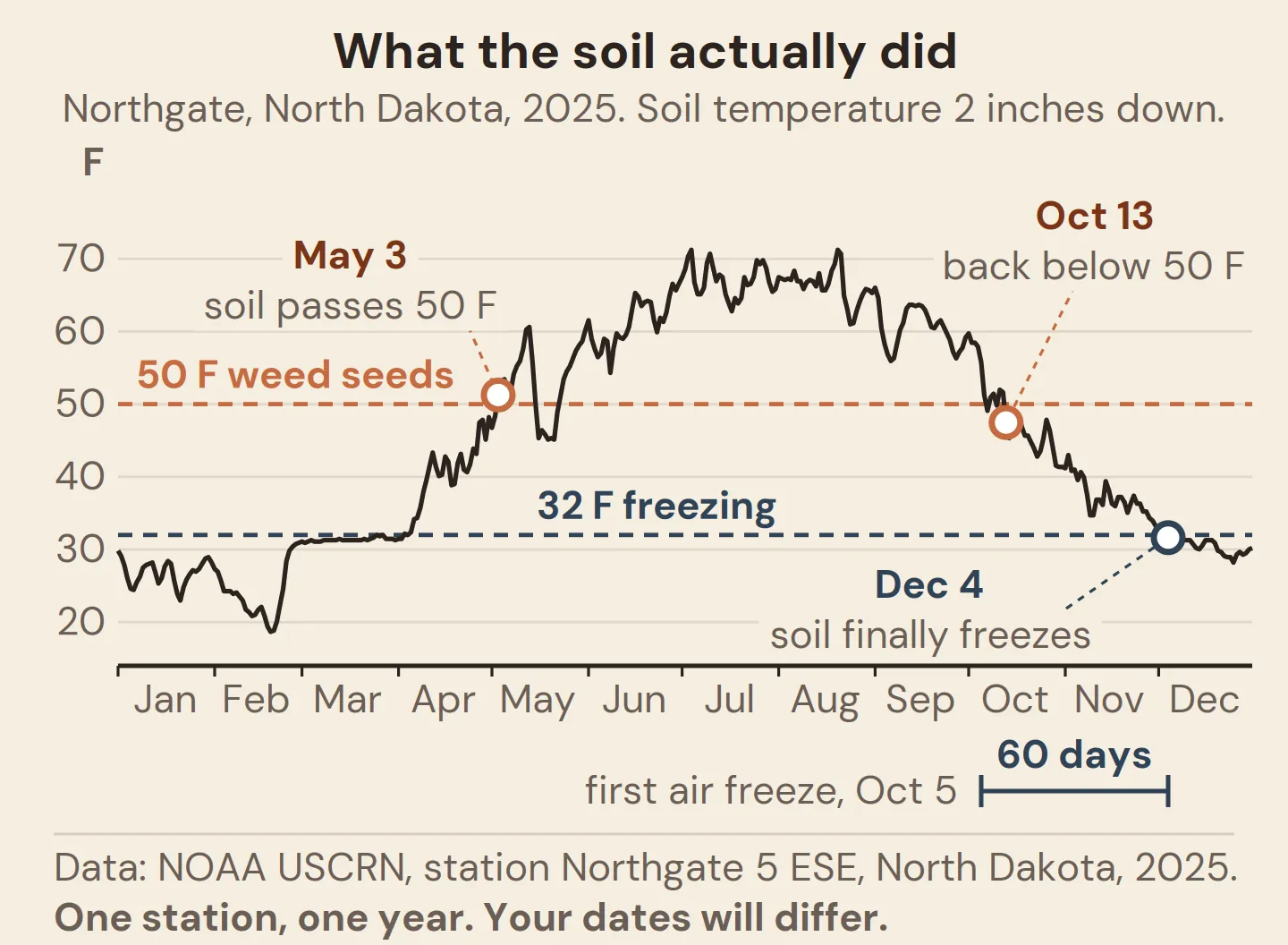
Virginia Tech Extension is blunt about the underlying point: mulch can be applied at any time of year. Timing does not decide whether mulch works. It decides how well it works, and which job it does best.
You will need a soil thermometer. Both Virginia Tech and Illinois Extension say to measure soil temperature rather than estimate it. Illinois opens its guidance with the point that planting by the calendar is too risky when a simple tool gives you a real number.
Spring: two goals that pull in opposite directions
Two extension services give opposite spring advice, and both are right.
Here is the part almost nobody explains: the two services are solving different problems.
Virginia Tech says to spread mulch in spring before the soil warms to about 50°F. The reason is weeds. Summer annual weed seeds germinate around that temperature, and mulch blocks the light they need. Get there first and they never start.
Washington State University says to mulch in mid-spring after the soil has warmed. Their reason is your plants. Mulch insulates in both directions. Lay it over cold spring soil and the soil stays cold, so growth is delayed.
So pick your problem. If last year’s weeds beat you, go early. If you are pushing for the earliest growth you can get, wait.
What does “the soil has warmed” actually mean?
A single reading will mislead you.
Illinois Extension notes that surface soil swings 10 to 20°F in one day, while deeper soil changes slowly and lags behind. Take readings in several spots, over several days, and average them.
Their method is simple. Push the probe to the depth that matters for what you are doing. For transplants, that is 4 inches. In dense soil, open a starter hole with a screwdriver so you do not bend the probe. Read between 6 and 8 in the morning, when soil is coolest and steadiest. A refrigerator thermometer with a probe is enough.
Illinois ties this to our purpose directly. Soil temperature is a guide not only for planting, but for when to expect germinating weeds. That is the basis for the 50°F rule in this guide.
What you will not find here is a soil temperature for “warm enough to help plants.” We looked. Several garden sites publish 55°F, but we could not trace that number to any university extension or government source. So we are not repeating it. Use your last spring freeze date and the plants themselves instead.
Vegetable beds and annuals: wait for the plants
Put the thermometer down and look at the plants.
For vegetables and annual flowers, Virginia Tech says to wait until plants are well established, 4 to 6 inches tall, before mulching around them.
Cool soil is the whole problem. Washington State’s point is that mulch laid early keeps soil temperature low and delays growth. Illinois Extension adds that cold soil encourages disease and can stunt a crop for the rest of the season. Mulch spread over a freshly seeded bed makes that worse.
Notice that this collides with the weed rule above. By the time seedlings are 4 to 6 inches tall, soil is well past 50°F and summer weeds have started. On a vegetable bed you cannot have both. The plants win, and you weed by hand until the mulch goes down.
Fall: the second weed window most people miss
Winter weeds germinate in fall, at the same 50°F line, in reverse.
Most people think of mulching as a spring job. That leaves a second window wide open.
Winter annual weeds, the ones that are somehow already green in February, germinate in fall. They use the same 50°F threshold in reverse. Virginia Tech’s fall rule is to get mulch down once soil temperature drops below 50°F, before those seeds start.
This is separate from winter protection, which is the next section. Fall weed mulching is about the surface of the bed. Winter protection is about the plants. They can happen in the same week, but they are not the same job and they do not share a trigger.
Before or after the ground freezes?
Mulch before the freeze to keep roots warmer, after the freeze to keep plants dormant.
Woody plants want the first. Herbaceous perennials, roses and tender crowns want the second. Decide what you are protecting and the timing follows.
That rule is our reading of the sources, not a quote from any one of them. The sources genuinely split here.
On the “before” side, Texas A&M says it is never too early to mulch, and to have it down before the first hard freeze in your area. K-State says before the ground freezes and before the first snow. Virginia Tech puts winter mulch in mid to late fall, once soil has cooled but before it freezes. Note that these are not quite the same deadline. A hard freeze is colder and comes later than a first freeze, so the earlier reading is the safer one.
On the “after” side, Washington State is specific about which plants it means: perennials, roses and tender shrubs. That mulch goes down in late fall, after the soil has frozen but before the coldest weather arrives. Iowa State, writing about potted plants heeled into a garden bed, waits until the top layer of soil has begun to freeze.
One note on that Washington State guidance: it appears in the 2024 edition of the C075 mulch guide. WSU rewrote the publication in 2025 and the winter-mulch passage is not in the current version, so we cite the edition the advice actually comes from and link both below. Iowa State still holds the same position.
“Before” and “after” sound like they are days apart. They are not.
At a NOAA station in northern North Dakota, the first freezing air of 2025 arrived on October 5. The soil two inches down did not drop below freezing until December 4. That is 60 days. The soil had crossed below 50°F on October 13, so the fall weed window opened almost two months before the ground froze.
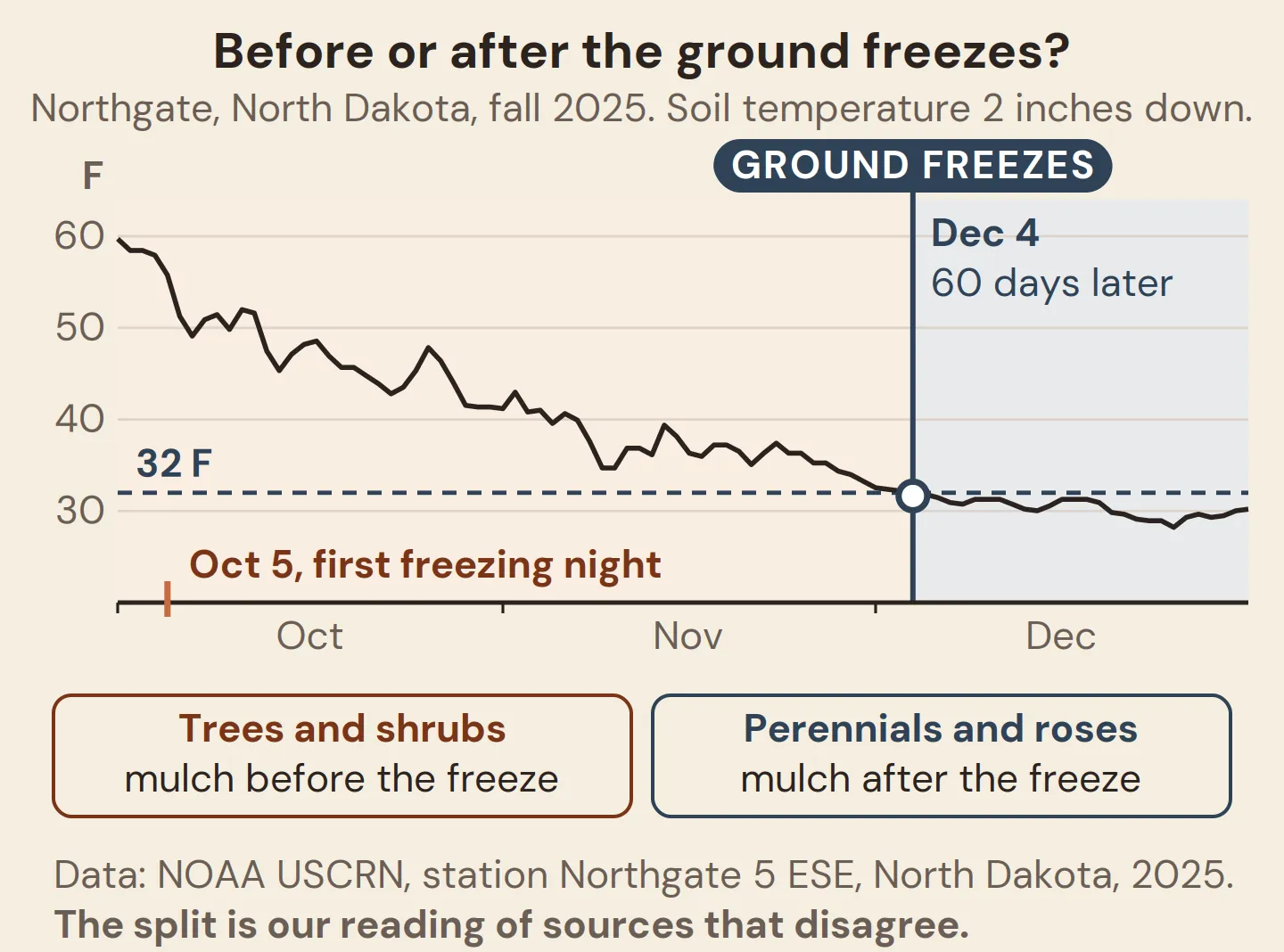
So the two sides are not arguing about the same week. They are arguing about two months. This is one station in one year and your dates will be different, but the gap is the point. If you are waiting for the ground to freeze, you are waiting a long time after the first freezing night.
The sharpest part is what each source says about heaving. Virginia Tech lists two things together as benefits of mulch: it delays soil freezing, and it reduces winter soil heaving. Iowa State says the opposite about the same mechanism. Delayed freezing is exactly what encourages heaving, and it can stop plants from going fully dormant.
University of Wisconsin-Madison explains what winter mulch is for, and it is not warmth. Contrary to popular belief, they write, winter mulch keeps the root zone from freezing and thawing over and over. That cycle heaves crowns and roots out of the ground, and it does the most damage when snow cover is thin or missing. If that is your goal, you want the soil frozen and staying frozen. That is the “after” logic.
One more thing, and this is our observation rather than any source’s. The “wait for the freeze” advice never appears in mild-climate guidance. That makes sense. NOAA notes that parts of Florida do not see a freeze every year, and the Florida Keys have never recorded freezing temperatures. In Zone 9, waiting for the ground to freeze means never mulching at all.
Winter depths are the exception. Growing-season beds want 2 to 4 inches. Winter protection runs deeper. Wisconsin gives 6 to 8 inches over the crowns of herbaceous perennials and ornamental grasses. Leave the dead stalks standing too; they add protection. Unprotected strawberries can suffer greater damage if temperatures drop to 18°F, so give them 2 to 4 inches of straw. Woody plants planted within the last five years, and marginally hardy ones, get about 6 inches of wood chips over the root zone.
Straw is sold by the bale, so the math is worth doing. Wisconsin says a bale covers about 100 square feet at least 3 inches deep. That is roughly 25 cubic feet, or 0.93 cubic yards. But winter crowns want 6 to 8 inches, and at that depth one bale covers far less.
Straw for a 300 sq ft perennial bed at winter depth
ExampleFor bark or wood chips, our mulch calculator does the same conversion.
When do you take winter mulch off?
Early spring, and the deadline is the plant, not the date.
Texas A&M says remove it before growth resumes. Iowa State, again writing about potted plants heeled into a bed, pulls theirs as soon as it thaws enough to lift. That is around mid-March in much of Iowa, which gives you a sense of the window in a cold state.
Wisconsin reduces rather than removes for young trees and shrubs. In mid to late spring, take that 6-inch winter layer back down to 2 or 3 inches, and pull it 6 inches clear of the trunk. That is your normal growing-season depth, and the bed is ready for summer.
Find your own two dates
Two dates do most of the work, and both are free to look up.
Your last spring freeze is the date after which temperatures are more likely to stay above 32°F than to fall below it again. Your first fall freeze is the mirror image. NOAA publishes both, built from thirty years of records at thousands of weather stations.
Know what the words mean, because mulching advice uses them loosely. NC State Extension defines a freeze as air temperature below 32°F, and a hard freeze as below 28°F. Frost is a different thing. It depends on humidity as well as temperature, so there is no single threshold, though the risk rises below 36°F. A freeze can happen without frost, and frost without a freeze. When a source says “after the first hard frost,” that is 28°F territory, not a light dusting in October.
NOAA’s tables give you probability, not just an average. A 10 percent date is the conservative choice, 50 percent is the middle, and 90 percent is the gamble. Pick based on what you would lose.
For scale, the first fall freeze in the Midwest and Northeast typically lands from mid-September to early October. In the South it runs from early October in Virginia down to December further south. South Florida’s last spring freeze is generally before January 16.
Your USDA hardiness zone is a different tool answering a different question. It is based on average annual extreme minimum winter temperature, so it tells you which of your plants live near their limit. University of Minnesota Extension puts it simply. Plants that are hardy for your zone should overwinter without help, and it is the borderline ones that need protecting. Your zone is how you find out which those are. It does not tell you when to mulch.
Frequently asked questions
Is it too late to mulch?
Almost never. Virginia Tech says mulch can be applied at any time of year. Late mulch still holds moisture, blocks light and protects soil. You may miss a weed window or a dormancy window, but the mulch still does its job.
Can I mulch in summer?
Yes. Summer is when mulch does its most visible work, keeping soil cooler and slowing evaporation. Water the bed deeply first, because mulch over dry soil seals the dryness in.
Do I have to clear off the old mulch first?
Not usually. Add enough to bring the bed back to depth, and check how deep that should be for your beds. How often you need to top up depends on the mulch you chose.
Do I mulch a newly planted tree right away?
Yes. New plantings are when mulch earns its keep. Keep it clear of the trunk and never mound it against the bark.
What if it snows before I get to it?
Snow is good winter mulch in its own right. Wisconsin points out that heaving does its worst when snow cover is thin or missing, so a reliable snowpack does much of the job for you. Mulch is your insurance for the winters that stay bare.
Related reading
Methodology & sources
Timing guidance drawn from university extension publications; freeze definitions and dates from NOAA and NC State. Where a publication has been revised since we cited it, we link both the edition the guidance appears in and the current version. Soil temperature data is a single NOAA USCRN station (Northgate 5 ESE, North Dakota, 2025), read directly from the daily record and shown as one worked example, not a national norm. All claims verified against original sources before publication.
Timing, soil temperature, and weeds
- Virginia Tech Extension — SPES-661P: Mulching: Purpose, Benefits, and Essential Information (2025) — link
- Washington State University Extension — C075: A Guide to Mulches, 2024 edition (the edition cited here for spring timing, the dry-soil warning, and winter mulch) — link
- Washington State University Extension — C075: Guide to Mulches, current 2025 revision — link
- Illinois Extension — Soil Thermometer: A Useful Toolbox Tool — link
- Iowa State Extension — Using Mulch in the Garden — link
- Mississippi State Extension — P2301: Mulches for the Landscape — link
Winter protection: before or after the freeze
- Texas A&M AgriLife Today — Five Steps to Prepare Your Garden for Winter (Arnold, 2024) — link
- K-State Research and Extension, Douglas County — Winterize Your Trees and Shrubs — link
- Iowa State Extension — Overwintering Unplanted Trees, Shrubs and Perennials — link
- University of Wisconsin-Madison Extension — Winter Mulch Your Landscape Plants (Pandian, 2020) — link
- University of Minnesota Extension — Mulching and Perennial Overwintering (2025) — link
Freeze dates, definitions, and data
- NC State Extension — AG-873: Interpreting Freeze/Frost Probabilities from NCEI — link
- NOAA NCEI — When to Expect the First Fall Freeze — link
- NOAA NCEI — When to Expect Your Last Spring Freeze — link
- NOAA USCRN — Daily data, station Northgate 5 ESE, ND, 2025 — link
- USDA ARS — Plant Hardiness Zone Map (2023) — link
Sources are cited for reference only. The institutions and retailers named on this page do not sponsor or endorse MaterialCalcs, and we are not affiliated with them. Retail prices, where shown, were checked by hand and vary by store and region.