

How deep should mulch be?
Most mulch belongs 2 to 4 inches deep — but the right number changes with your plants, your soil, and how coarse the mulch is. Here's the depth for every common bed, and how to avoid going too deep.
Most mulch belongs 2 to 4 inches deep, and 3 inches is a safe default for the majority of beds. But the right number isn’t fixed — it shifts with what you’re mulching, what your soil is like, and how coarse the mulch is. Too deep and you can suffocate roots or rot bark; too thin and weeds push through while the soil dries out.
This guide gives the depth for every common situation, then the reasoning so you can adjust for your own yard. Every number comes from university extension and arborist guidance. Planning how much to buy? Our free mulch calculator turns your bed size and depth into cubic yards and bags in seconds.
Most beds: 2 to 4 inches deep, with 3 inches a safe default.
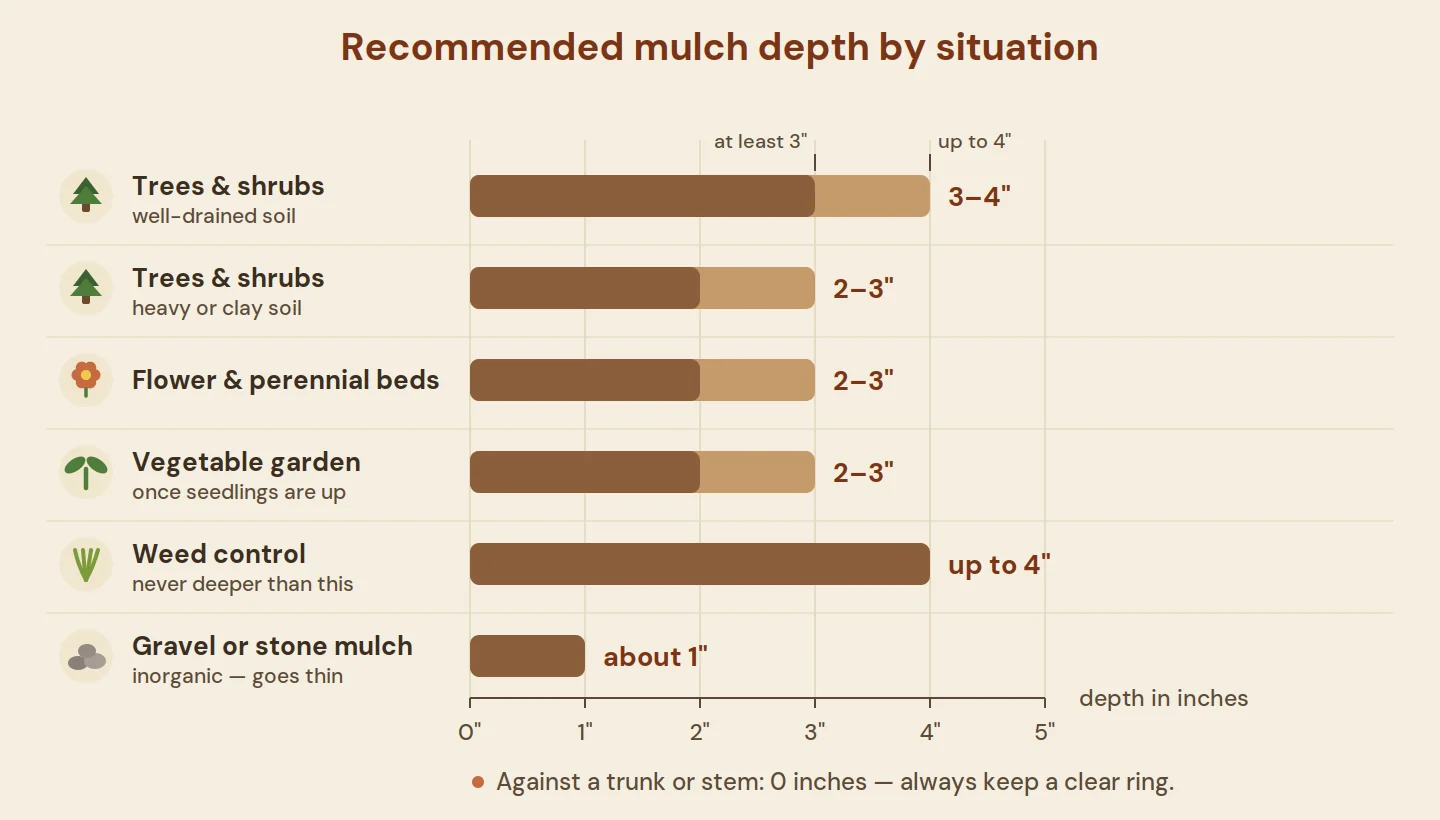
Trees & shrubs: 3–4″ on well-drained soil, 2–3″ on clay. Flower beds: 2–3″. Vegetables: 2–3″. Weed control: up to 4″. Gravel: ~1″. Against the trunk: nothing — keep a clear ring.
The rule: coarse mulch goes deeper, fine goes thinner; heavy clay soil less, sandy soil more; never exceed 4 inches.
Mulch depth by situation
There’s no single right depth, because the honest answer depends on your situation. Find your case below, then read on for why.
| What you’re mulching | Depth | Notes |
|---|---|---|
| Trees & shrubs (well-drained soil) | 3–4″ | Extend to the drip line if you can |
| Trees & shrubs (heavy or clay soil) | 2–3″ | Thinner, so the ground doesn’t waterlog |
| Flower & perennial beds | 2–3″ | Fine bed mulch packs down — don’t overdo it |
| Vegetable garden | 2–3″ | Pull back to about 1″ right around seedlings |
| For weed control (maximum) | Up to 4″ | More doesn’t help; clear weeds first |
| Gravel or stone (as mulch) | ~1″ | Inorganic — much thinner than wood |
| Against a trunk or plant stem | 0″ | Keep a mulch-free ring, always |
How deep should mulch be around trees and shrubs?
Drainage decides where you land in the range.
For trees and shrubs, use 3 to 4 inches on well-drained ground and 2 to 3 inches on heavy or clay soil (Iowa State Extension). A thick blanket over clay traps water and starves roots of oxygen, while looser soil can carry a little more. Spread the ring out toward the drip line — the outer edge of the branches — if you can, and keep the root flare, where the trunk widens into roots, visible (ISA).
How deep should mulch be in flower beds?
Two to three inches — and go lighter on fine mulch.
Flower and perennial beds do well at 2 to 3 inches. Beds usually get finer material — shredded bark, pine fines, leaf compost — and fine mulch packs down, so past 3 inches it can seal off air and water (ISA, University of Maryland Extension). Leave about an inch of space around plant stems so they don’t stay wet. Boxwood is the exception worth knowing: Maryland Extension caps mulch over shallow-rooted shrubs like boxwood at 1 inch, because a deeper layer cuts off oxygen to those surface roots. Azaleas are a different note — Maryland’s advice there is about material rather than depth: pine bark or pine needles.
How deep should mulch be in a vegetable garden?
Two to three inches, once the seedlings are up.
Keep a 2- to 3-inch layer in the vegetable garden (UF/IFAS). You’ll see many sites say 1 to 2 inches for vegetables — extension guidance runs a little higher, because 2 to 3 inches is what reliably holds moisture and blocks weeds. The 1-inch figure does belong somewhere, though: UF/IFAS puts it right around seedlings and small transplants, where a thicker layer causes growth problems.
Timing matters more here than in ornamental beds. Mulch direct-seeded rows only after the seedlings are up and established, and keep mulch pulled back an inch or so from each stem to prevent stem rot. Lightweight materials — straw, shredded leaves, pine needles — break down faster and feed next season’s soil.
How deep should mulch be for weed control?
Four inches is the ceiling, not a target.
To smother weeds, you can go up to about 4 inches — the top of the range (Colorado State Extension). More than that doesn’t help, and it starts causing the problems below. If a spot has weed pressure so heavy that 4 inches won’t hold it, the answer isn’t a deeper pile — it’s clearing the established weeds first, then mulching normally. Mulch stops new weeds from sprouting; it won’t kill what’s already rooted.
How soil and mulch texture change the number
Two dials that move you within the 2–4 inch range.
Your soil. On heavy, slow-draining clay, stay at the low end, 2 to 3 inches, so water still moves and roots can breathe (Iowa State). On sandy, fast-draining soil, use the high end, 3 to 4 inches, to hold more moisture.
Your mulch texture. Coarse, chunky mulch — bark nuggets, arborist wood chips — has air gaps and won’t compact, so it can sit at 3 to 4 inches. Fine mulch — grass clippings, sawdust, screened compost — mats down and smothers soil, so keep it near 2 inches, or 1 inch for very fine material (ISA, University of Maryland). Inorganic gravel or stone used as mulch goes thinnest of all, about an inch (University of Maryland).
What goes wrong if the depth is off?
Too deep is the bigger danger.
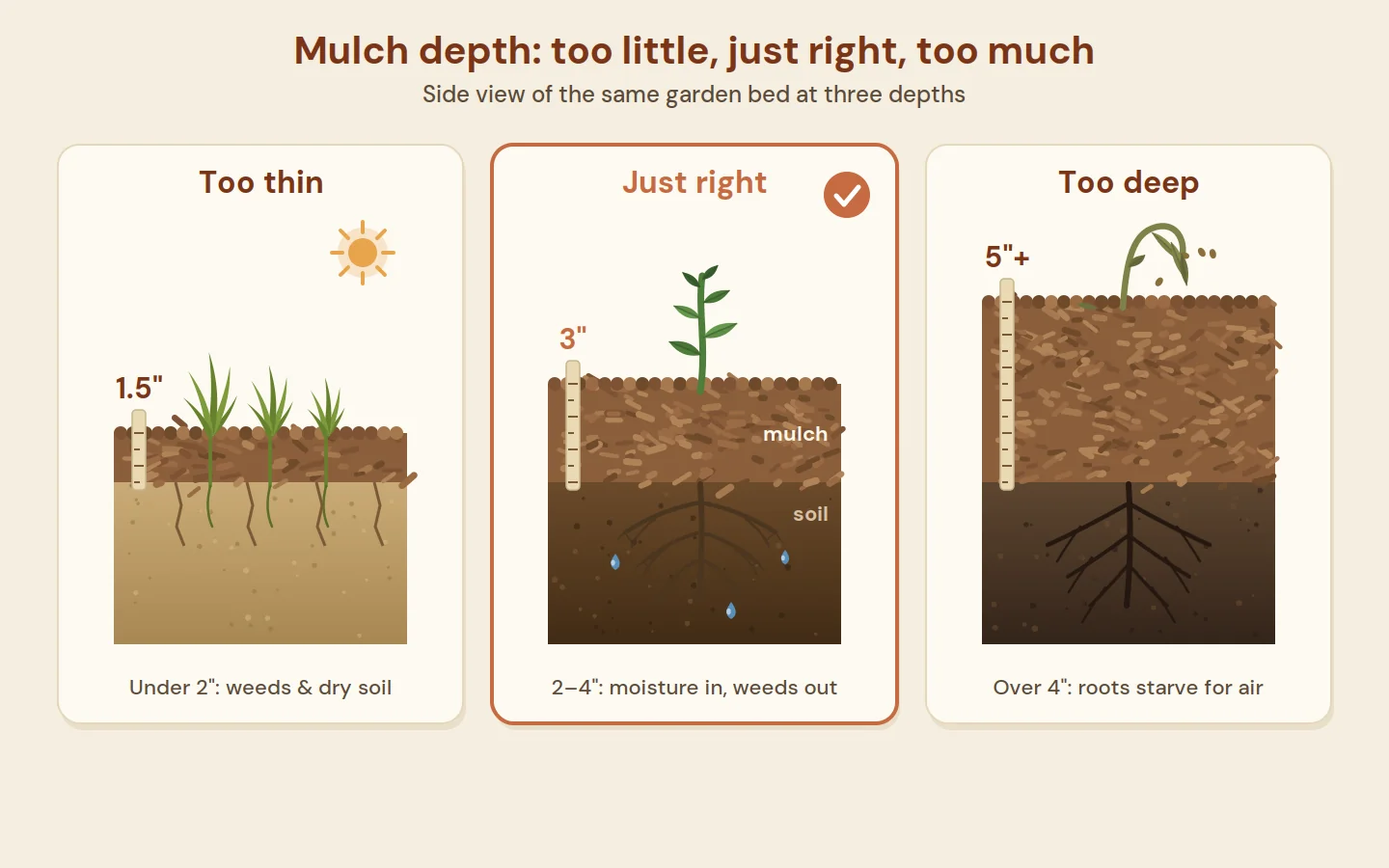
Too deep is the more common and more damaging mistake. Past 4 inches — or a volcano against a trunk — mulch holds too much moisture at the plant’s base, blocks oxygen to the roots, and can cause root and bark rot (Rutgers, ISA). On heavy soil it can waterlog the ground entirely (Iowa State). Rutgers draws the line earlier than most: it caps the total at 3 inches, including anything left from previous years, and at 2 inches on compacted or poorly drained soil.
Too thin fails the other way. Under about 2 inches, mulch won’t block light from weed seeds or hold moisture, so weeds sprout and the soil dries out. USDA NRCS lists 2 inches as the minimum for wood mulch to even stay in place during heavy rain and wind.
Three inches, for most beds, is the sweet spot. In Michigan State University trials, a 3-inch layer of wood chips cut midday soil temperature by roughly 18°F — real protection, with none of the downside of a deeper pile.
How to check and top up your mulch depth
Measure first — that’s the whole trick.
Push a ruler or a marked stick straight down through the mulch to the soil to read your current depth, then add only what you need to reach target — not a full fresh layer every year. Adding a full layer on top of what’s already there is exactly how beds creep to 5 and 6 inches without anyone noticing.
Topping up a 300 sq ft bed
ExampleFor how far a given amount of mulch stretches at each depth, see how much a yard of mulch covers. For when to refresh by mulch type, see how long mulch lasts.
Frequently asked questions
Is 4 inches of mulch too much?
For coarse mulch on well-drained soil, or when you’re mulching to control weeds, 4 inches is the top of the safe range — Penn State Extension and the International Society of Arboriculture both put the ceiling there. For fine mulch or heavy clay soil it’s too deep; stay at 2 to 3 inches. Rutgers Extension is stricter still, capping the total at 3 inches including any old mulch, and 2 inches on compacted or poorly drained soil. Never exceed 4 inches with organic mulch.
How deep should mulch be around a tree?
Two to four inches in a wide ring, never touching the trunk. Use the lower end on heavy or clay soil and the higher end on well-drained ground. Keep the bark and root flare — the swelling where the trunk meets the soil — clear of mulch.
Do I need to remove old mulch before adding new?
Not every year. If you’re under your target depth, rake the old layer to break up any crust and top up to depth. Remove and replace mulch only every few years, or sooner if it’s matted, smells sour, or has visible mold.
How deep should rubber or gravel mulch be?
Thinner than wood — about 1 inch. Inorganic mulches like gravel, stone, and rubber don’t break down or compress the way wood does, so a shallow layer is enough (University of Maryland Extension).
Should I add extra because mulch settles?
Yes. Fresh mulch loses some depth as it weathers and compacts, so applying at the top of your target range and letting it settle toward the middle is fine. Just don’t exceed 4 inches to start.
Related reading
Methodology & sources
Depth guidance drawn from university extension and arborist publications. All figures verified against original sources before publication.
Depth by situation, plant type, and soil
- Iowa State Extension — How Deep Should Mulch Layer Be? — link
- International Society of Arboriculture — Proper Mulching Techniques — link
- University of Maryland Extension — Mulching Trees and Shrubs — link
- University of Maryland Extension — Excess Mulch Problems — link
- UF/IFAS — EP625: Mulching Herbs, Vegetables and Fruit Trees in the Florida-Friendly Edible Landscape — link
- Colorado State Extension — CMG GardenNotes #245: Mulching — link
Over-mulching and root health
- Rutgers NJAES — FS099: Problems With Over-Mulching Trees and Shrubs — link
- Penn State Extension — Mulching Landscape Trees — link
Soil temperature and minimum coverage
- Michigan State University Extension — Mulching Landscape Beds FAQs — link
- USDA NRCS — Conservation Practice Standard 484: Mulching — link
Sources are cited for reference only. The institutions and retailers named on this page do not sponsor or endorse MaterialCalcs, and we are not affiliated with them. Retail prices, where shown, were checked by hand and vary by store and region.