

Bulk vs. bagged mulch: which should you buy?
At regular prices, bags are cheaper up to about 5 cubic yards. Above that, bulk delivery saves money. During spring sales, bags beat bulk at any size. The full math plus a flowchart.
Choosing between bulk and bagged mulch sounds simple until you start doing the math. The store has bags stacked to the ceiling. A landscape supplier offers delivery by the cubic yard. One costs more per bag, the other charges a delivery fee. Which actually saves money?
It depends on two things: how much you need and when you buy. We ran the numbers and the answer is more nuanced than most homeowners expect. If you already know your quantity, our free mulch calculator figures out the cost both ways in seconds.
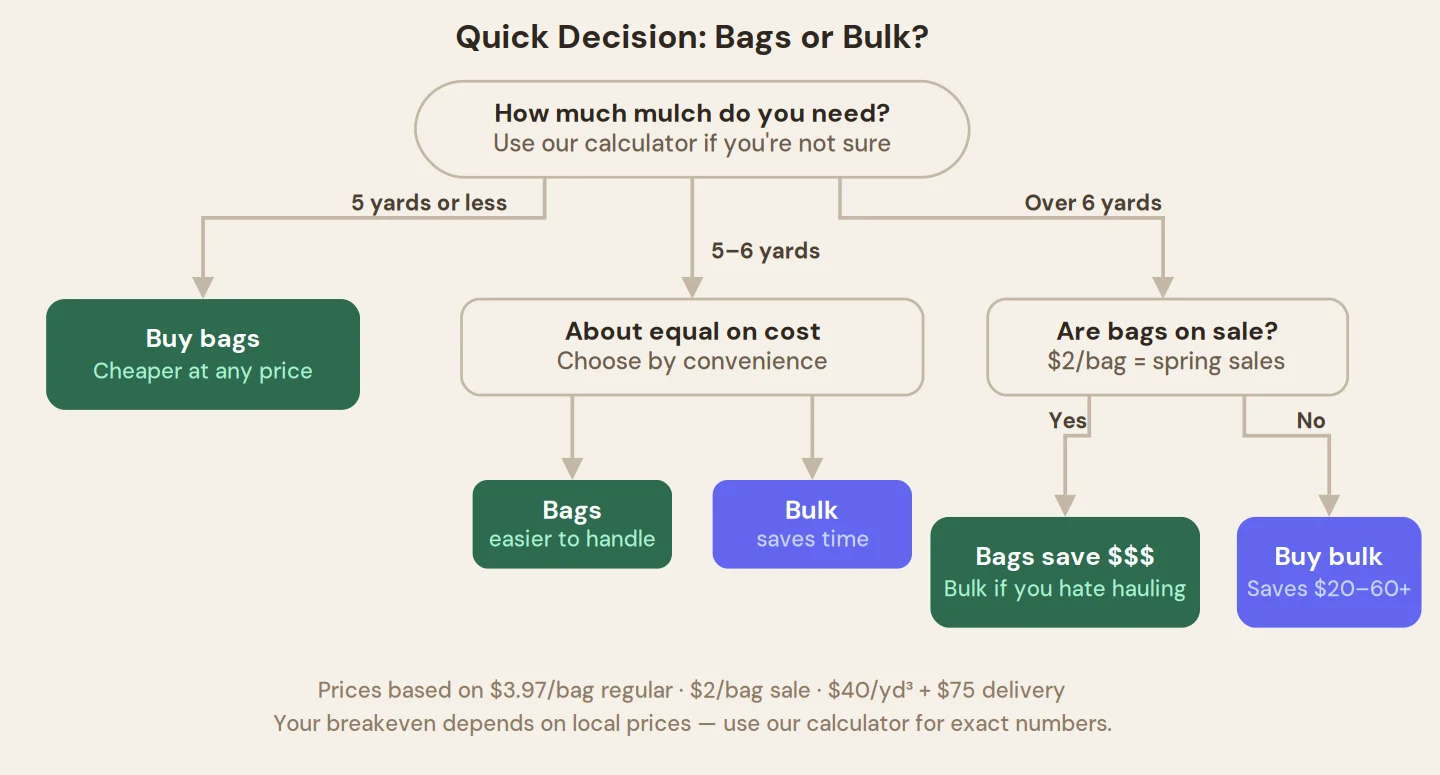
5 cubic yards or less: bags are almost always cheaper at regular prices — and far cheaper during spring sales ($2/bag).
Over 6 cubic yards: bulk delivery starts saving money at regular prices, but bags still win during sales if you don’t mind hauling.
The breakeven: around 5–6 cubic yards at typical regular prices ($3.97/bag vs. $40/yd³ + $75 delivery).
The short answer
There’s no single right answer — it depends on project size and timing.
The numbers in the box above tell the story, but they assume typical prices. Your local bulk rate, delivery fee, and sale timing can shift the breakeven in either direction. Below, we break down exactly how bagged and bulk mulch are priced, run a side-by-side cost comparison, and cover the non-price factors — convenience, quality, and time — that often tip the decision.
How each is sold
Bags come in standardized cubic-foot sizes. Bulk is sold by the cubic yard and delivered loose.
Bagged mulch. Home Depot, Lowe’s, and Walmart all sell mulch in bags. The most common size is 2 cubic feet — the Vigoro and Sta-Green bags you see stacked outside every spring. Home Depot also sells Scotts Earthgro bags at 1.5 cubic feet, which matters during sales because the bags look the same price but hold less. One 2 cu ft bag covers about 8 square feet at 3 inches deep — roughly a 2 × 4 foot strip. Regular price runs about $3.97 to $3.98 per bag for standard hardwood mulch, working out to roughly $2 per cubic foot.
Bulk mulch. Landscape suppliers sell by the cubic yard. One cubic yard equals 27 cubic feet — the same as about 14 standard bags. Price ranges from $30 to $55 per cubic yard depending on the type (hardwood bark on the low end, cedar on the high end). Delivery is separate. Most suppliers charge $50 to $150 depending on distance and minimum order. Some require at least 1–2 cubic yards. The mulch arrives loose in a dump truck and gets dumped in a pile on your driveway. From there, it’s wheelbarrows and shovels.
If you have a truck, you can skip delivery. A full-size pickup, filled level, holds about 2.5 cubic yards (UNH Cooperative Extension) — enough to cover around 270 square feet at 3 inches deep.
Cost comparison — bags vs. bulk
The math depends on quantity, price, and delivery fee. Here’s a real comparison.
200 sq ft garden bed at 3 inches
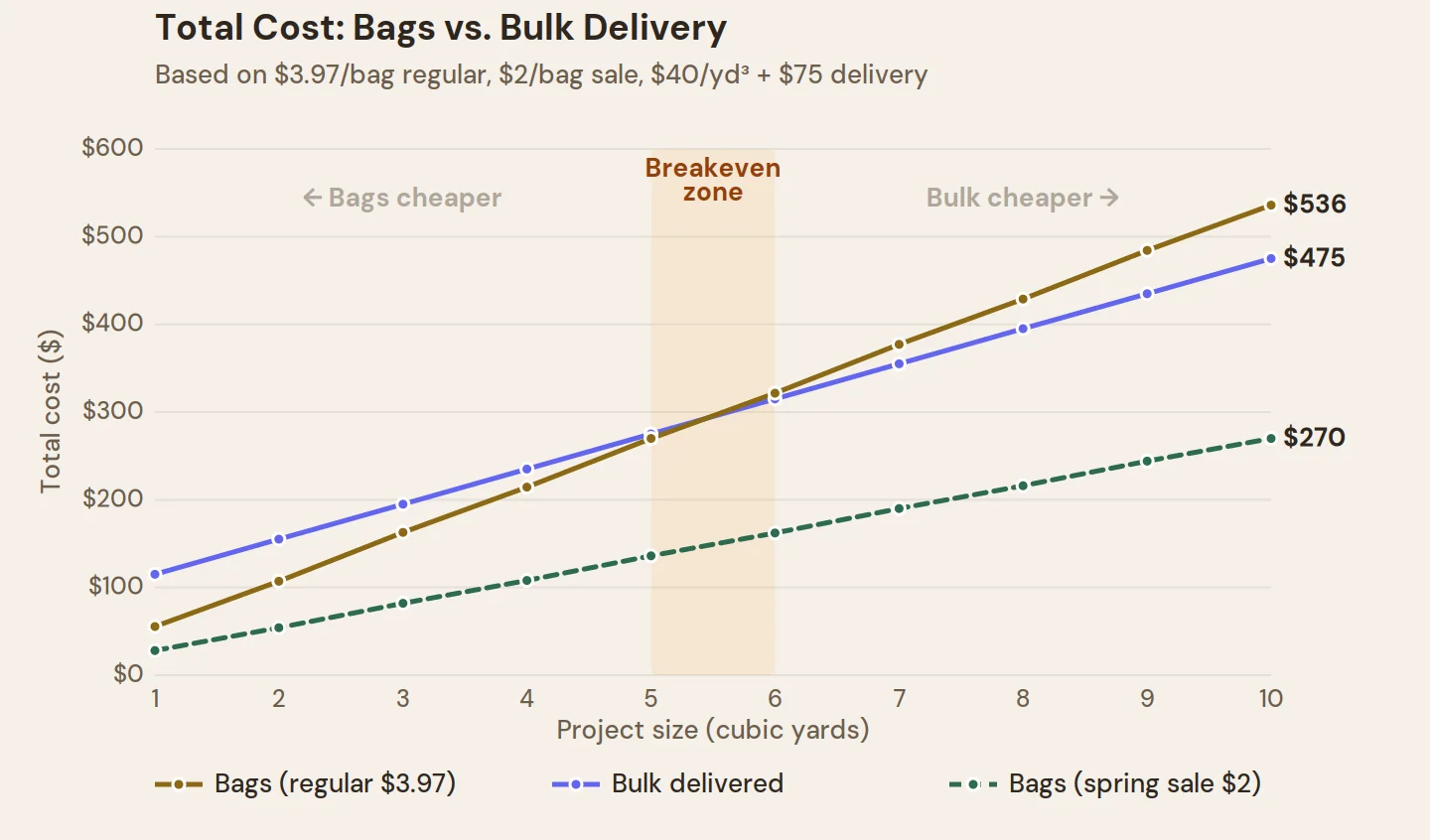
ExampleHere’s how the costs scale with project size (using $3.97/bag, $40/yd³ bulk, $75 delivery):
| Project size | Bags needed | Bags (regular) | Bags (sale $2) | Bulk delivered | Cheaper option |
|---|---|---|---|---|---|
| 1 yd³ | 14 | $56 | $28 | $115 | Bags by $59+ |
| 3 yd³ | 41 | $163 | $82 | $195 | Bags by $32+ |
| 5 yd³ | 68 | $270 | $136 | $275 | Roughly equal* |
| 8 yd³ | 108 | $429 | $216 | $395 | Bulk by $34 (regular) / Bags by $179 (sale) |
| 10 yd³ | 135 | $536 | $270 | $475 | Bulk by $61 (regular) / Bags by $205 (sale) |
*At 5 yd³ the difference is only $5 at regular prices. Sale prices still favor bags. Actual breakeven depends on your local bulk price and delivery fee.
When bags actually beat bulk
Bags win more often than most people think.
Any project up to 5 cubic yards. At regular prices, bags are simply cheaper. The delivery fee on bulk wipes out the per-yard savings.
Spring sale timing. At $2/bag, bags beat bulk at every quantity. Even 10 cubic yards of bags costs $270 versus $475 for bulk delivery.
No driveway or staging space. Apartments, townhomes, or narrow side yards may have no place to dump a bulk load. Bags go exactly where you need them.
Small annual top-ups. If you’re adding an inch or two each spring, you probably need 1–2 cubic yards. Not worth a bulk delivery for that.
When bulk is the clear winner
For large projects at regular prices, bulk delivery saves money and time.
6+ cubic yards at regular prices. Once you cross roughly 5–6 cubic yards, bulk starts saving real money. At 10 cubic yards, you’d save about $61 versus regular-priced bags.
Convenience at any volume. Hauling 80+ bags from the store, loading them in your car in multiple trips, tearing them open, and dealing with the plastic waste — that takes hours. One bulk delivery saves you the trip entirely. Your Saturday stays yours.
Variety and freshness. Landscape suppliers typically offer more mulch types than big-box stores. The product is often fresher, too, because it hasn’t been sitting in sealed bags for months.
Quality differences you should know
Bagged and bulk mulch aren’t identical products — even if they look similar.
Bagged mulch tends to have a finer, more uniform texture because the screening process removes larger particles. Bulk mulch is coarser and less consistent — which isn’t a problem, it just looks different.
Free mulch — the third option
Free mulch exists — but it comes with tradeoffs.
Many municipalities offer free compost or wood chips from yard waste recycling programs. The catch: these materials may contain pesticide residues from treated lawns and gardens. Ask your local program what goes into the mix.
The easiest free option? Fallen leaves. Shred them with a mower and spread them around beds. They decompose faster than bark but add excellent organic matter to the soil.
Common mistakes
- Forgetting delivery costs. A $40 cubic yard sounds cheaper than $56 worth of bags — until you add the $75 delivery fee. Always compare total project cost, not unit price.
- Ignoring bag size during sales. Home Depot and Lowe’s both run “$2 per bag” sales, but bag sizes differ. One store may sell 2 cu ft bags while another sells 1.5 cu ft at the same price. Compare price per cubic foot, not price per bag.
- Buying bulk for a small project. Under 3 cubic yards, bags are almost always the better deal. The delivery fee alone can cost more than the mulch itself for small orders.
- Forgetting the time cost of bags. Loading 80 bags into a cart, driving home, unloading, and tearing each one open is nobody’s idea of a good Saturday. If your time has value, bulk delivery might be worth the premium even when bags are technically cheaper.
Frequently asked questions
How many bags of mulch equal a cubic yard?
One cubic yard is 27 cubic feet. In standard 2 cu ft bags, that’s 14 bags. In 1.5 cu ft bags, you’d need 18. In 3 cu ft bags, 9 will do it. Always round up — stores won’t sell you half a bag. For a deeper breakdown, see how many bags of mulch are in a cubic yard.
Is it cheaper to buy mulch in bulk or bags?
It depends on how much you need and when you buy. At regular prices, bags are cheaper for anything under about 5 cubic yards. Above 6 cubic yards, bulk delivery starts saving money. During spring sales ($2/bag), bags are cheaper at every quantity — even 10 cubic yards.
How much bulk mulch fits in a pickup truck?
A full-sized pickup holds about 2.5 cubic yards when filled level to the top of the bed. A midsize or compact truck typically holds about 1.5 cubic yards. Always check your truck’s payload rating before loading — wet mulch weighs significantly more than dry.
When is the best time to buy bagged mulch?
Spring sales run from March through May at most major retailers, with the best deals typically appearing around early April and Memorial Day. Prices drop to roughly $2 per bag — about half the regular price. Stock up then, even if you’re not ready to spread it yet.
Can I get mulch for free?
Yes. Municipal composting programs often give away wood chips. Tree trimming companies may deliver free loads to avoid landfill fees. Shredded fallen leaves also work well as mulch. Just be aware that municipal mulch may contain pesticide residues, and free tree chip loads can be very large — plan your staging space.
Does bagged mulch go bad?
Not really. Sealed bags can sit for months without issues. If bags get torn or sit in standing water, the mulch inside can start to mold or develop a sour smell. Spread those bags first and let the mulch air out — the smell disappears within a day or two.
Related reading
Methodology & sources
Purchasing guidance, cost data, and quality safety information drawn from university extension publications. Retail prices verified against HomeDepot.com and Lowes.com in April 2026.
Purchasing guidance and cost data
- Mississippi State Extension — P2301: Mulches for the Landscape — link
- Texas A&M AgriLife Extension — How Much Compost, Soil, or Mulch? — link
- Alabama Cooperative Extension — Mulches for the Home Landscape — link
Quality and safety
- Oregon State Extension — EC-1629: Mulching Woody Ornamentals with Organic Materials — link
- Penn State Extension — Mulch: A Survey of Available Options — link
- UMass Amherst — Colored Bark Mulch — link
Coverage and application
- Clemson Extension — Mulch Matters — link
- UNH Cooperative Extension — Mulching Trees and Shrubs — link
Pricing
- HomeDepot.com — retail bag pricing verified April 2026
- Lowes.com — retail bag pricing verified April 2026
Sources are cited for reference only. The institutions and retailers named on this page do not sponsor or endorse MaterialCalcs, and we are not affiliated with them. Retail prices, where shown, were checked by hand and vary by store and region.